
Living in an apartment doesn’t mean giving up on your fitness goals. The right apartment home gym essentials make it entirely possible to train effectively, protect your floors, and keep the peace with your neighbors. The real challenge isn’t motivation. It’s knowing what to buy, what to skip, and how to make every square foot count. This guide walks you through the smartest compact gym equipment for apartments, from adjustable dumbbells to noise-dampening flooring, so you can build a setup that works for your space, your budget, and your lifestyle.
Table of Contents
- Key takeaways
- 1. Key criteria for choosing apartment home gym essentials
- 2. Adjustable dumbbells: the cornerstone of compact strength training
- 3. Compact cardio equipment that won’t disturb your neighbors
- 4. Flooring and supportive gear to protect your space
- 5. How to set up a home gym: a comparison guide for every budget
- My honest take on building an apartment gym that actually lasts
- Build your apartment gym with Couchanddumbells
- FAQ
Key takeaways
| Point | Details |
|---|---|
| Start with a realistic budget | A solid starter setup costs under $500 and covers the core essentials. |
| Prioritize multi-use equipment | Adjustable dumbbells and resistance bands replace multiple single-purpose items without taking over your space. |
| Noise control is non-negotiable | Layered flooring with anti-vibration pads protects your relationship with downstairs neighbors. |
| Foldable gear preserves your living space | Benches, walking pads, and racks that fold flat let your apartment stay an apartment between workouts. |
| Match gear to your training goals | Cardio-focused setups need different tools than strength-focused ones, so plan before you buy. |
1. Key criteria for choosing apartment home gym essentials
Before you spend a dollar on home workout equipment, get clear on four things: your available floor space, your noise tolerance, your training goals, and your budget. Skipping this step leads to impulse buys that end up collecting dust in a closet.
Here’s what to evaluate before purchasing any small space fitness gear:
- Space efficiency. Measure your workout zone before ordering anything. Foldable gear stores flat against walls or behind furniture, which keeps your living room functional between sessions.
- Noise impact. Dropping weights, jumping, and running in place all transmit vibration through floors. Choose equipment designed to minimize impact and pair it with proper flooring.
- Versatility. The best exercise tools for home do more than one job. A set of adjustable dumbbells, for example, covers dozens of movements across strength, hypertrophy, and conditioning.
- Budget tiers. A starter setup runs under $500, a builder setup lands between $500 and $1,500, and a dream setup can reach $4,000 or more. Know your tier before browsing.
- Flooring protection. Your apartment lease likely holds you responsible for floor damage. Protective mats are not optional.
Pro Tip: Sketch your workout zone on paper with measurements before buying anything. A 6x8 foot area is enough for a surprisingly capable setup if you choose gear wisely.
2. Adjustable dumbbells: the cornerstone of compact strength training
If you buy only one piece of home workout equipment for your apartment, make it a set of adjustable dumbbells. They are the single most space-efficient strength tool available, and they replace what would otherwise be an entire rack of fixed weights.
Adjustable dumbbells replace entire racks and come with soft-coated handles that reduce noise when set down, which matters enormously in an apartment. A starter set covering 5 to 50 pounds handles everything from shoulder raises to Romanian deadlifts without requiring more floor space than a shoebox.
Key features to look for when shopping:
- Dial or selector mechanism. Dial-style sets like the Bowflex SelectTech adjust in seconds. Pin-style sets are slightly slower but often more durable.
- Weight range. Beginners do well with a 5 to 25 pound range. Intermediate and advanced lifters should look for sets that extend to 50 or 90 pounds.
- Handle coating. Rubber or neoprene coatings muffle the sound of setting weights down, a small detail that makes a real difference in apartment living.
- Storage dock. Most adjustable sets come with a tray or dock. Use it. Storing plates properly extends the life of the mechanism and keeps your space tidy.
A single compact kettlebell in the 8 to 16 kg range also adds variety. Kettlebells work well for swings, carries, and presses, rounding out metabolic finishers without adding bulk to your setup.
3. Compact cardio equipment that won’t disturb your neighbors
Cardio in an apartment requires more thought than cardio in a house. Treadmills at full speed, jump rope on hardwood, and high-impact aerobics all create vibration that travels directly to the unit below. The good news is that several compact cardio options deliver real results with minimal noise.
Mini steppers are one of the most underrated pieces of small space fitness gear available. Mini steppers burn significant calories in just 15 to 20 minutes and take up no more floor space than a small side table. They are quiet, affordable, and easy to slide under a bed or desk when not in use.
Walking pads and foldable treadmills are a step up in investment but offer a genuine cardio workout. Foldable treadmills fold flat and slide under most sofas or bed frames, making them a practical option even in studio apartments. Use them at walking or light jogging speeds to keep noise manageable.
Compact exercise bikes are another strong option. Upright bikes with a small footprint work well in corners, and many fold for storage. Cycling is inherently low-impact, which means minimal vibration transfer to the floor below.
Pro Tip: Place a thick rubber mat under any cardio machine, even a mini stepper. It absorbs vibration at the source before it reaches your subfloor, which is where most neighbor complaints originate.
4. Flooring and supportive gear to protect your space
Your flooring setup is the foundation of every workout in your apartment. Get it wrong and you risk floor damage, noise complaints, and injury. Get it right and your apartment gym feels professional and intentional.
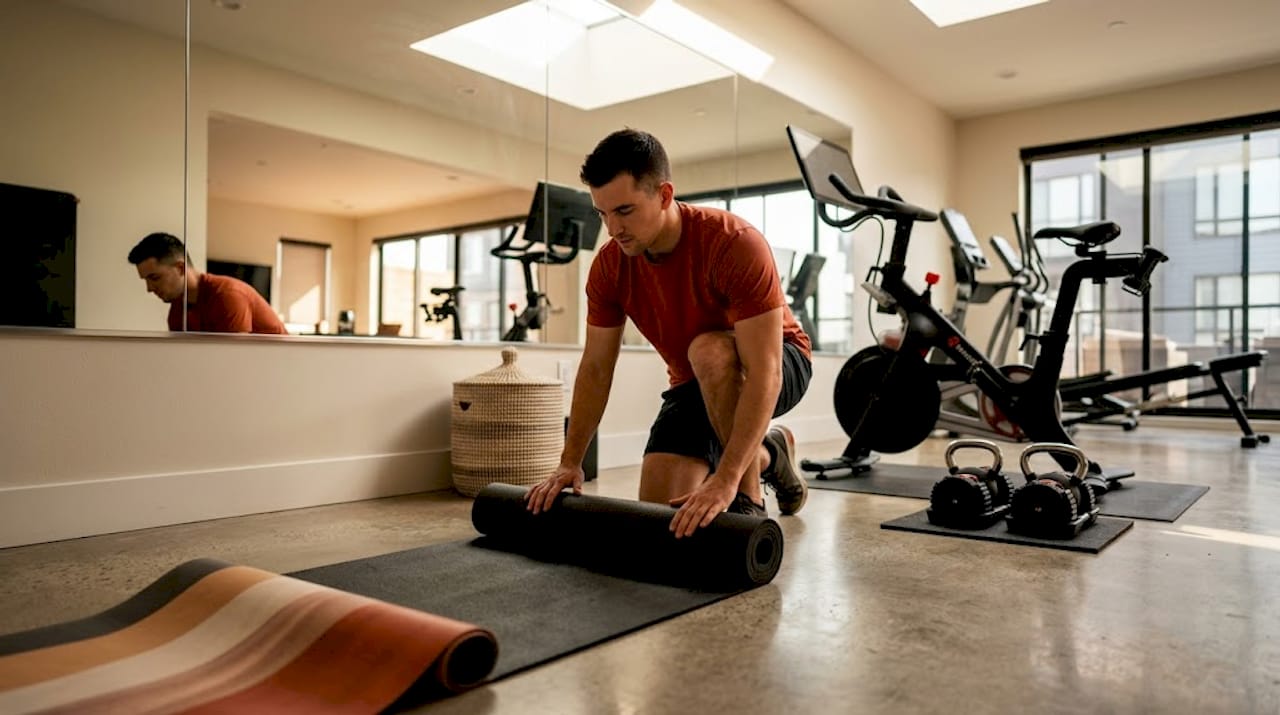
The recommended approach uses a layered system. Start with a 1/4 inch anti-vibration underlayment as your base layer, then add a 3/4 inch high-density EVA mat on top. This combination decouples vibration from your subfloor, which is the primary source of transmitted noise in apartment buildings.
For renters specifically, 15mm rubber tiles are an excellent choice. They require no adhesive, protect the original floor, and come up cleanly when you move out.
Beyond flooring, here is the supportive gear that rounds out a well-equipped apartment setup:
| Item | Purpose | Space needed | Noise impact |
|---|---|---|---|
| Foldable adjustable bench | Pressing, rows, step-ups | Folds flat against wall | Low |
| Resistance bands with door anchor | Full-body pulling and pushing | Hangs on door hook | None |
| Foam roller | Muscle recovery and mobility | Stands upright in corner | None |
| Lacrosse ball | Targeted trigger point release | Fits in a drawer | None |
| Anti-vibration mat | Floor and noise protection | Stays under equipment | Reduces significantly |
Foldable benches tuck behind furniture or against walls, and resistance bands hung on a hook behind a door add a full pulling and pressing range of motion without occupying any floor space at all. These items are the definition of must-have fitness accessories for apartment living.
5. How to set up a home gym: a comparison guide for every budget
Knowing what to buy is only half the work. Knowing what to buy first is what keeps you from overspending or building a setup that doesn’t match your goals. Here is a side-by-side look at how the main equipment categories stack up, followed by a budget-tier breakdown.
| Equipment | Footprint | Cost range | Noise level | Versatility |
|---|---|---|---|---|
| Adjustable dumbbells | Very small | $150–$500 | Low | Very high |
| Mini stepper | Small | $30–$100 | Very low | Moderate |
| Foldable treadmill/walking pad | Medium (folds flat) | $300–$800 | Moderate | Moderate |
| Compact exercise bike | Medium | $200–$600 | Low | Moderate |
| Resistance bands set | Minimal | $20–$60 | None | High |
| Foldable adjustable bench | Medium (folds flat) | $100–$300 | Low | High |
| Wall-mounted functional trainer | Wall space only | $1,500–$3,500 | Very low | Very high |
For those wondering how to set up a home gym on a realistic budget, here is a practical three-tier framework:
Starter (under $500): Adjustable dumbbells, resistance bands, a high-density mat, and a mini stepper. This covers strength, cardio, and recovery in a minimal footprint.
Builder ($500 to $1,500): Add a foldable bench, a walking pad, and a layered flooring system. Your training options expand significantly without major space sacrifice.
Dream ($1,500 and up): Consider a wall-mounted functional trainer or a digital resistance system like the Tonal 2. Wall-mounted systems require zero floor space for weights and offer guided, quiet strength training. Cable-based exercises are inherently quieter than free weights, making them a natural fit for apartment living at any level.
Pro Tip: Buy your flooring before your first piece of equipment. It’s the one item that protects everything else, including your lease deposit.
My honest take on building an apartment gym that actually lasts
I’ve seen a lot of apartment gym setups, and the ones that fail share one thing in common: they start with the wrong equipment. Someone buys a full-size power rack because it looks impressive online, then spends three months frustrated by a space that no longer functions as a living room.
In my experience, the people who build lasting home workout setups are the ones who embrace constraints rather than fight them. A 5 to 50 pound adjustable dumbbell set, a quality mat, and a set of resistance bands will take most people further than a room full of machines they can’t use comfortably.
What I’ve also learned is that noise is the issue most people underestimate. You can manage your own discomfort. You cannot manage a neighbor who files a complaint with your building management at 7 a.m. on a Saturday. Investing in a proper layered flooring system is not a luxury. It is the thing that keeps your gym viable long-term.
My practical advice: start small, buy quality over quantity, and add one piece at a time as your training evolves. A setup that grows with you is worth far more than a complete kit that overwhelms your space from day one. The goal is a gym that supports your lifestyle, not one that competes with it.
— Brian Dunn, Couch & Dumbbells
Build your apartment gym with Couchanddumbells
At Couchanddumbells, we believe your home should support both how you live and how you move. Our curated selection of compact gym equipment for apartments is chosen with urban spaces in mind, from space-saving fitness gear to premium recovery tools that store cleanly and look great in your home. Whether you’re starting with a single mat and a dumbbell set or building out a full compact training zone, you’ll find gear that fits your space and your aesthetic. Explore our fitness journal for setup guides, training tips, and honest gear reviews written for people who take both their home and their health seriously.
FAQ
What are the most important apartment home gym essentials?
Adjustable dumbbells, a high-density mat, resistance bands, and a foldable bench cover the core of strength and mobility training in a small space. Add a mini stepper or walking pad for cardio without significant noise impact.
How do I reduce gym noise in an apartment?
Use a layered flooring system with an anti-vibration underlayment and a thick rubber or EVA mat on top. This decouples vibration from the subfloor and significantly reduces noise transmitted to neighbors below.
Can I build a home gym in a studio apartment?
Yes. Focus on gear that folds or stores vertically, such as adjustable dumbbells, resistance bands, and a foldable bench. A 6x8 foot workout zone is enough for a full-body training routine when equipment is chosen thoughtfully.
How much does a starter apartment gym cost?
A functional starter setup typically costs under $500 and includes adjustable dumbbells, resistance bands, a foldable bench, and a protective mat.
Are resistance bands worth including in an apartment gym?
Resistance bands are one of the highest-value items in any compact gym setup. They add pulling and pressing movements, store in a single drawer, make no noise, and cost as little as $20 for a full set.