
Most personal trainers and fitness-minded individuals know the frustration: you want to build client home workout program equipment setups that actually work, but you’re staring down a mix of limited budgets, cramped apartments, and clients with wildly different goals. The gap between what a client owns and what a good program demands can feel wide. The good news is that it doesn’t have to be. With the right intake process, a smart equipment sequence, and programming built on proven principles, you can design a client home fitness plan that delivers real results, no matter how modest the starting setup.
Table of Contents
- Key Takeaways
- Build client home workout program: assess needs first
- The right equipment in the right order
- Designing programs around what the client has
- Common pitfalls and how to avoid them
- My honest take on home program design
- Find the right gear at Couchanddumbells
- FAQ
Key Takeaways
| Point | Details |
|---|---|
| Start with client assessment | Identify goals, space, budget, and experience before purchasing any equipment. |
| Prioritize versatile gear | Adjustable dumbbells, resistance bands, and a power rack cover the widest range of training needs. |
| Build programs around progressive overload | Small, consistent weight increases matter more than a perfect or complex program. |
| Plan for small increments | Large weight jumps cause stalls; fractional plates and adjustable tools keep progress moving. |
| Track and adapt regularly | Use simple logs or apps to measure progress and update both equipment and programming over time. |
Build client home workout program: assess needs first
Before you recommend a single piece of equipment or write one workout, you need to ask the right questions. Skipping this step is where most plans go wrong.
Start by clarifying the client’s primary fitness goal. Strength training, muscle building, general conditioning, and weight loss each call for different equipment priorities and program structures. A client chasing a 200-pound deadlift needs something fundamentally different from someone who wants to stay active and mobile at 55.
Next, get specific about space. Measure the actual footprint available for equipment storage and training. Quantifying a client’s space before recommending gear avoids wasted purchases and directly improves workout consistency. A 10x10-foot spare room and a 6x6-foot corner of a living room lead to completely different equipment lists.
Budget is just as concrete. Know the number before you suggest gear. A realistic beginner home gym setup covers far more than people expect. Cover these key intake questions with every client:
- What is the primary fitness goal (strength, endurance, fat loss, general health)?
- How much space is dedicated to training and storage?
- What is the total budget for initial setup and future additions?
- What is the client’s training history and current fitness level?
- Does the client have any injuries, movement limitations, or preferences?
Pro Tip: Ask clients to send a photo or video of their training space before your first program design session. What they describe and what actually exists are often very different things.
Equipment progression matters too. A complete beginner may start with bands and bodyweight, then need dumbbells within three months. Building that expected progression into the initial plan saves money and avoids the frustration of buying equipment twice.
The right equipment in the right order
Buying home gym equipment without a plan wastes money. The sequence in which you acquire gear shapes both safety and long-term progress.
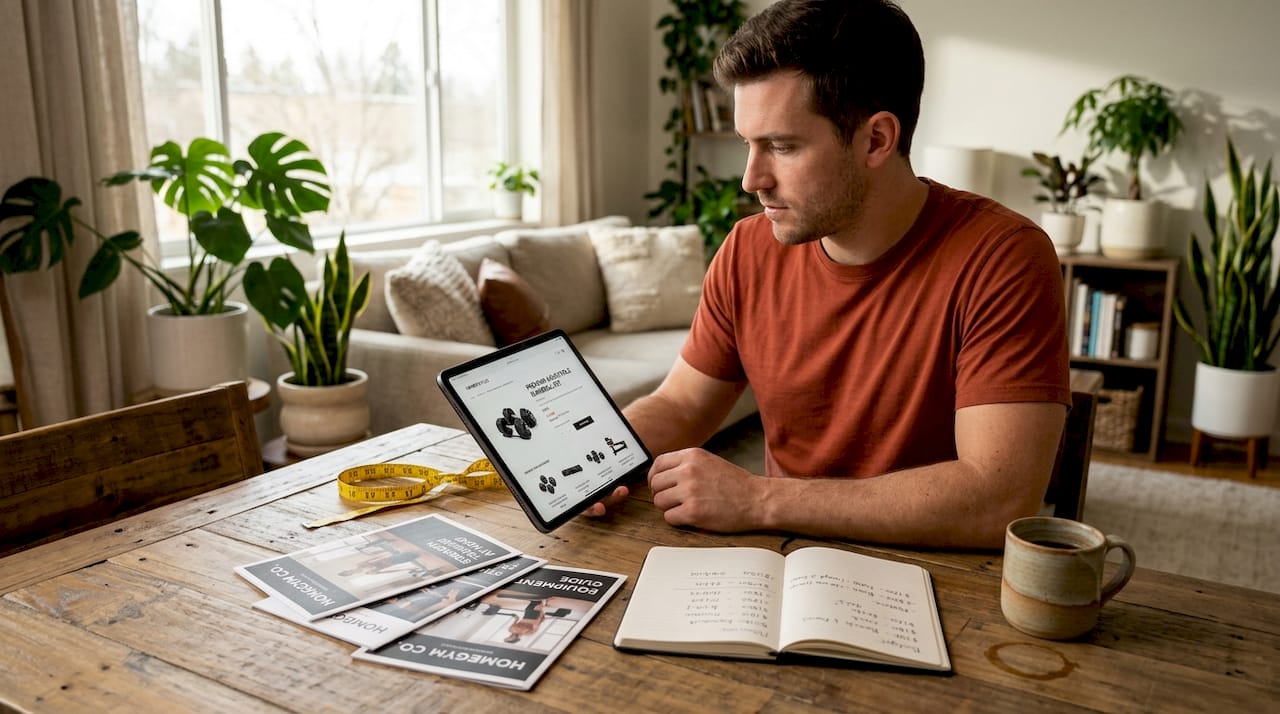
The recommended purchase sequence for a serious home strength setup is a barbell with plates first, then a power rack for safety, followed by an adjustable bench, flooring, and then accessories. This order exists for a reason: the barbell and plates give you the most versatile, scalable resistance tool available. The power rack makes solo lifting safe, enabling squats, bench press, and overhead press without a spotter.
A complete beginner build covering those components, including flooring and a pull-up bar, costs around $1,055 and supports 12 to 18 months of beginner progression. That is an accessible one-time investment compared to years of gym membership fees.
For clients with smaller spaces or tighter budgets, adjustable dumbbells and resistance bands offer the best value at entry level. They are compact, affordable, and adaptable across a wide range of exercises and fitness levels. Foldable benches and portable fitness gear extend this setup without consuming permanent floor space.
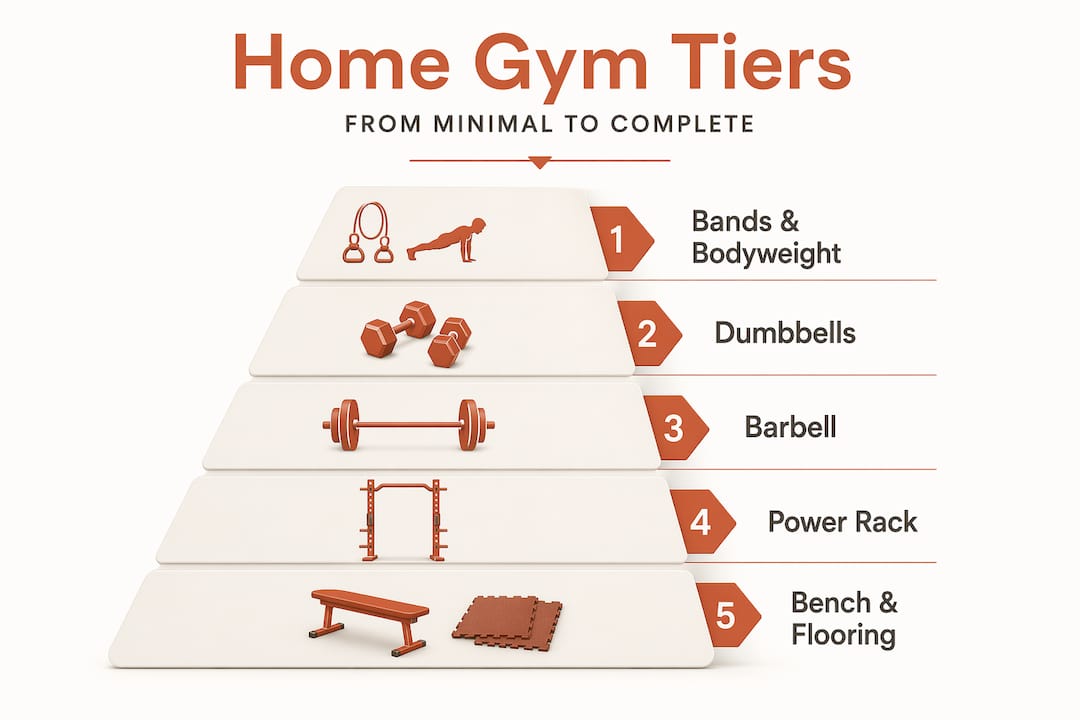
Here is a comparison of three common starter builds:
| Build tier | Core equipment | Estimated cost | Best for |
|---|---|---|---|
| Minimal | Resistance bands, bodyweight | Under $100 | Beginners, very small spaces |
| Intermediate | Adjustable dumbbells, foldable bench | $300 to $600 | Most clients with moderate space |
| Full strength | Barbell, plates, power rack, bench | $900 to $1,200 | Serious strength goals, garage or room |
Pro Tip: Always budget for rubber flooring. It protects the floor, reduces noise, and makes heavy lifts safer. This is the most commonly skipped item and one of the most regretted omissions.
Thinking through gym accessories storage early prevents equipment from ending up scattered across a room and going unused. Organization directly affects adherence.
Designing programs around what the client has
Once you know the equipment, the program design process becomes clear. The core principles do not change based on what gear is available. What changes is how you apply them.
ACSM guidelines emphasize training all major muscle groups at least twice per week with any form of resistance for meaningful gains. That means your program structure, not your equipment list, drives results. Here is a practical framework for building a home workout program across equipment tiers:
- Identify the weekly training frequency. Three full-body sessions per week works well for beginners. Intermediate clients may benefit from an upper/lower split across four days.
- Select compound movements first. Squats, hinges (deadlifts or Romanian deadlifts), pushes (press variations), and pulls (rows, pull-ups) cover every major muscle group with minimal equipment.
- Assign progressive overload targets. Set a specific rep goal for each exercise. When the client hits the top of the rep range for two consecutive sessions, increase the weight or resistance.
- Add accessory work last. Isolation exercises for arms, shoulders, or core fill in gaps after compound work is done. Bands and light dumbbells handle this well even in minimal setups.
- Build in deload weeks. Every four to six weeks, reduce volume or intensity by 30 to 40 percent. This is especially helpful in home settings where clients may train without coaching feedback.
- Review and update the program every four to six weeks. Progression stalls, life changes, and equipment additions all require programming adjustments.
Simple programs built on linear progression, training three times per week with compound movements, consistently outperform complex periodization plans for beginners. And training to failure is not necessary for most healthy adults to make consistent gains. Keeping the program approachable keeps clients showing up.
Pro Tip: Give every home client a written log, even if it is just a notes app template. Clients who track their workouts progress faster and stay more motivated than those who train from memory.
Common pitfalls and how to avoid them
Even a well-designed plan runs into real-world friction. Knowing the common problems ahead of time lets you solve them before they derail progress.
- Equipment overflow. Buying too much gear too fast leads to a cluttered space that feels overwhelming. Guide clients to add equipment only when they have genuinely outgrown what they own.
- Large weight increments. Standard weight plates jump in 5 or 10-pound increments, which is too aggressive for upper body pressing movements in beginners. Small weight step sizes prevent stalls. Fractional plates that add 1.25 or 2.5 pounds are inexpensive and make a significant difference in long-term adherence.
- Training without a spotter. This is a genuine safety concern. Power racks with adjustable safety bars solve the barbell safety problem. For clients without a rack, program dumbbell variations that allow safe bail-out at any rep.
- Adherence issues from space or time pressure. Compact equipment stored efficiently reduces the psychological friction of setting up a workout. If getting started takes ten minutes of moving furniture, the client will find reasons to skip.
- Unused equipment. Large, single-purpose machines are the most common source of buyer’s remorse in home gyms. Versatile, adjustable equipment maximizes value and actual use.
Consistency beats complexity. A client who trains three times per week with a set of adjustable dumbbells and a good program will outperform someone with a full garage gym and an inconsistent schedule every time.
Motivation tends to follow momentum. When clients see their numbers go up in a simple log, they stay engaged. Your job is to build systems that make showing up the path of least resistance.
Tracking progress and setting realistic expectations
Results from a home workout setup are measurable and real, but timelines need honest communication.
| Progress marker | Beginner timeline | Intermediate timeline |
|---|---|---|
| Strength gains (5 to 10%) | 4 to 6 weeks | 6 to 10 weeks |
| Visible muscle changes | 8 to 12 weeks | 12 to 20 weeks |
| Improved endurance | 3 to 4 weeks | 4 to 8 weeks |
| Consistent adherence | 3 to 5 weeks to form habit | Ongoing with programming variety |
Simple tracking tools work best for home clients. A notes app, a Google Sheet, or a dedicated fitness app like Strong or Hevy keeps records without adding friction. What matters is that clients record weight, sets, and reps each session, so you can adjust programming based on real data rather than guesswork. For clients focused on hypertrophy, equipment that allows gradual loading increases directly supports muscle development. When a client plateaus, that is almost always a signal to update the program or add a new resistance variable, not to give up.
My honest take on home program design
I’ve worked with enough clients in home settings to say this with confidence: the biggest mistake is overcomplicating things before the client has even established a consistent habit.
I’ve seen trainers write intricate periodization models for clients who have never trained twice in the same week. I’ve watched people spend $2,000 on equipment in month one and abandon it by month three. What actually works is simpler than the fitness industry wants to admit.
In my experience, the best client home fitness plan starts with the minimum equipment needed to cover every major movement pattern, a program that feels slightly too easy at first, and a check-in system that keeps accountability alive. You build complexity on top of consistency, not the other way around.
The clients who surprise me with their progress are rarely the ones with the best equipment. They are the ones who show up, log their sessions, and add five pounds when the program tells them to. For small space training, this approach is especially powerful because it removes every possible barrier between the client and their next workout.
Start small. Build the habit. Add gear and complexity as the client grows into them. That is the real home personal trainer framework that delivers lasting results.
— Brian Dunn, Couch & Dumbbells
Find the right gear at Couchanddumbells
Building a home workout space that you genuinely want to use starts with equipment that fits your life. At Couchanddumbells, you will find curated home fitness gear designed to work in real spaces, not just spacious garages. From compact resistance tools to full fitness exercise machines that complement any program tier, the selection is built around quality, function, and the kind of design that makes your space feel intentional. Whether you are outfitting a client setup or building your own home gym from the ground up, Couchanddumbells makes it easy to find what you need and feel good about where you are training.
FAQ
What equipment do I need to build a client home workout program?
The minimum effective setup includes adjustable dumbbells, resistance bands, and a sturdy mat. For clients focused on strength progression, adding a barbell, plates, and a power rack significantly expands training options.
How much does a beginner home gym cost?
A beginner strength-focused setup covering a power rack, barbell, plates, bench, flooring, and pull-up bar costs approximately $1,055, enough to support 12 to 18 months of structured progression.
How do I create a workout routine at home without a trainer?
Follow a three-day-per-week full-body program built around compound movements like squats, rows, and presses. Track your weights and reps each session, and increase resistance when you complete the top of your rep range for two sessions in a row.
How do I keep a client motivated in a home workout program?
Keep the program simple and progressive, provide a written tracking system, and check in regularly. Clients stay motivated when they see clear evidence of progress, and compact, well-organized equipment reduces the friction of getting started.
Is home workout equipment as effective as a gym?
Yes. Consistent training that covers all major muscle groups at least twice per week produces meaningful strength and fitness gains regardless of the setting. Programming quality and training consistency matter more than equipment quantity.