
You don’t need a gym membership, a rack of weights, or even a dedicated room to build real strength and fitness. When you decide to build a home workout routine no gym required, the biggest obstacle isn’t equipment. It’s knowing how to structure your time, progress your effort, and stay consistent. This guide gives you exactly that: a practical framework for creating a fitness routine at home that delivers results from day one, using nothing but your body and the floor beneath you.
Table of Contents
- Key Takeaways
- How to build a home workout routine no gym required
- Creating your weekly home workout plan
- Progressing your routine for real results
- Common challenges and how to work through them
- What you can realistically expect
- My honest take on building this kind of routine
- Ready to move more comfortably at home?
- FAQ
Key Takeaways
| Point | Details |
|---|---|
| No equipment required | Bodyweight training builds real strength when paired with structured progression. |
| Frequency beats perfection | Training all major muscle groups 2 to 4 times per week drives consistent results. |
| Progressive overload applies at home | Increase reps, rounds, or exercise difficulty to keep your body adapting over time. |
| Short sessions are sustainable | A 20-minute workout with warm-up, circuit, and cooldown is enough to make progress. |
| Consistency is the actual strategy | The best home workout plan is the one you follow week after week without burnout. |
How to build a home workout routine no gym required
Before you write down a single exercise, you need to understand what makes bodyweight training work. The short answer: your muscles don’t know whether resistance comes from a barbell or your own body. What they respond to is tension, challenge, and recovery.
Bodyweight training builds strength through exactly the same principles as gym-based lifting. You apply resistance, your muscles fatigue, you recover, and you come back slightly stronger. The key is that you must keep increasing the challenge over time. Without that, progress stops.
Here’s what a solid foundation for your bodyweight training schedule looks like:
- Train all major muscle groups. Your routine should cover pushing movements (chest, shoulders, triceps), pulling movements (back, biceps), lower body (quads, hamstrings, glutes), and core. Skipping any of these creates imbalances over time.
- Hit each muscle group at least twice a week. Consistency over complexity is the principle the ACSM emphasizes in its updated 2026 resistance training guidelines. Two quality sessions per muscle group per week is the minimum that produces measurable strength gains.
- Apply progressive overload. This means increasing reps, volume, or difficulty over time. When 10 push-ups feel easy, you move to 15. When 15 feel manageable, you progress to pike push-ups or archer push-ups.
- Plan rest days intentionally. Your muscles grow during recovery, not during the workout itself. Rest or active recovery (a walk, light stretching) is part of the plan, not a skip day.
- Keep sessions short enough to sustain. Short sessions reduce beginner burnout and make it easier to stay consistent week after week.
Pro Tip: If you are new to no equipment exercises, start with two training days per week and add a third day after two weeks. This gives your joints and connective tissue time to adapt before you increase volume.
Creating your weekly home workout plan
Now that you understand the principles, here is how to put together a practical home workout plan that you can start this week.

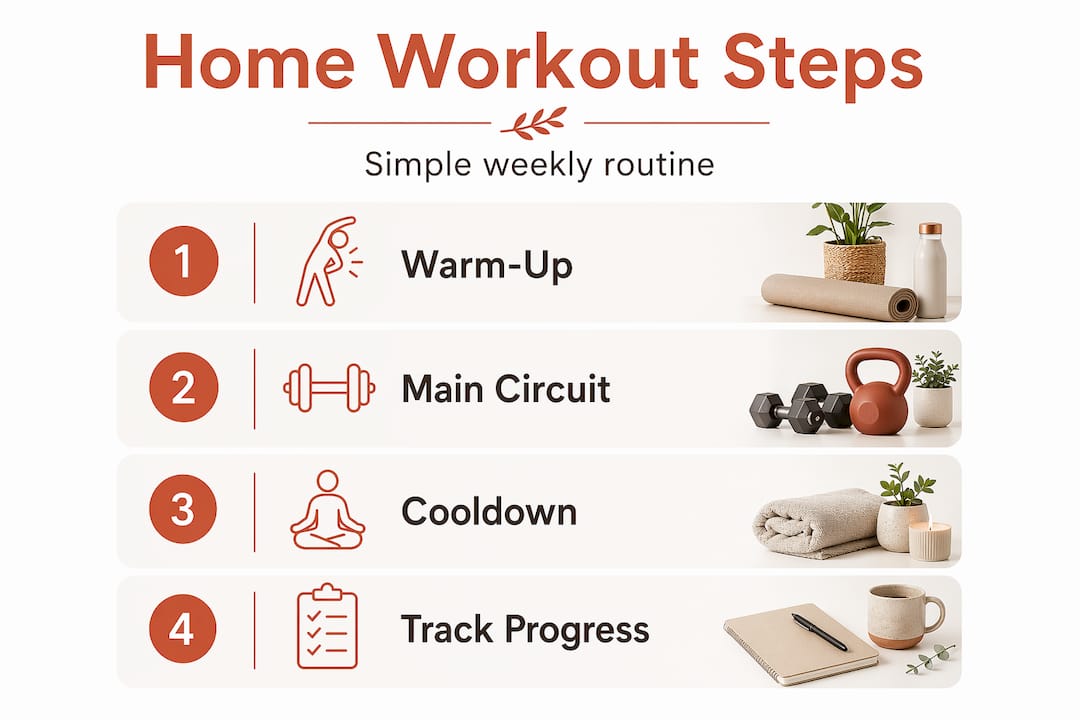
The structure that works best for beginners is three to four training days per week with rest or light activity in between. A 20-minute session that includes a warm-up, main circuit, and cooldown is enough to drive progress without burning you out. This is the same format used in structured 30-day beginner programs that have helped thousands of people create a fitness routine at home.
Here is a simple weekly structure to follow:
- Day 1 (Monday): Full body circuit. Squats, push-ups, walking lunges, plank holds, and jumping jacks. Aim for 3 rounds with 30 to 60 seconds of rest between rounds.
- Day 2 (Tuesday): Active recovery. A 20 to 30 minute walk, light yoga, or gentle mobility work. This keeps blood flowing without adding training stress.
- Day 3 (Wednesday): Full body circuit with variations. Glute bridges, incline push-ups or standard push-ups, reverse lunges, hollow body hold, and high knees.
- Day 4 (Thursday): Rest. Full rest supports muscle repair and prepares you for the second half of the week.
- Day 5 (Friday): Full body circuit. Return to Day 1 exercises, but try to add one to two reps per set compared to Monday.
- Day 6 (Saturday): Optional light activity. A walk, a stretch session, or an outdoor yoga flow.
- Day 7 (Sunday): Full rest. Let your body fully recover before the next week begins.
The table below shows a sample beginner session structure you can follow for each training day:
| Phase | Duration | What to do |
|---|---|---|
| Dynamic warm-up | 3 minutes | Leg swings, arm circles, hip rotations, light jogging in place |
| Main circuit | 14 minutes | 3 rounds of squats, push-ups, lunges, plank, and cardio burst |
| Cooldown | 3 minutes | Standing quad stretch, hamstring stretch, deep breathing |
A beginner routine from Nerd Fitness shows how practical this can be: 20 squats, 10 push-ups, 10 walking lunges per leg, a 15-second plank, and 30 jumping jacks, repeated with 48 hours of rest between sessions. It covers every major movement pattern without a single piece of equipment.
Progressing your routine for real results
Getting started is one thing. Getting better is where most people stall. If you do the same 10 push-ups and 20 squats every week for months, your body will stop adapting. Here is how to keep moving forward when you workout at home without weights.
The foundation is progressive overload, applied creatively:
- Increase repetitions. If you did 10 push-ups last week, aim for 12 this week. Small jumps add up fast over months.
- Add rounds. Move from 2 rounds to 3, then from 3 to 4. More total volume means more stimulus for your muscles.
- Progress to harder exercise variations. Standard squats become jump squats or single-leg squats. Push-ups become close-grip or decline push-ups. Each variation shifts the mechanical challenge without adding weight.
- Shorten rest periods. Cutting rest from 60 seconds to 45 seconds increases cardiovascular demand and overall workout density.
- Use household items for pulling resistance. Milk jug rows and similar improvised exercises train the upper back effectively at home. A sturdy table edge can support bodyweight rows too.
Tracking your progress is just as important as making it. Keep a simple log: date, exercises, sets, reps, and how you felt. When you look back after 30 days, you will see clear evidence that your no equipment exercises are working. That visibility is one of the strongest motivators you have.
Pro Tip: Take a photo or video of your push-up or squat form every two weeks. This gives you a visual record of progress and helps you catch form breakdowns before they become injuries.
Common challenges and how to work through them
Even a well-designed bodyweight training schedule runs into real obstacles. Here is how to handle the most common ones honestly.
Losing motivation mid-week is the most common issue. The fix is reducing friction, not willpower. Lay out your workout clothes the night before. Keep your sessions short enough that skipping feels harder than just doing it. Tying your workout to an existing habit, like working out right after your morning coffee, also helps.
Stalling progress happens when you stop applying overload. Without progressive overload in reps, tempo, or range of motion, bodyweight routines plateau even when the exercises feel challenging. Review your workout log and find one variable to increase this week.
Form breaking down under fatigue is a genuine injury risk at home where no trainer is watching. If your lower back arches during push-ups or your knees cave during squats, regress to an easier variation until your strength catches up.
“The warm-up is not optional. A dynamic warm-up of 10 to 20 minutes optimizes neuromuscular readiness and reduces injury risk more effectively than static stretching before exercise.”
If an exercise feels too hard, use a regression. Wall push-ups before floor push-ups. Step-back lunges before forward lunges. Strength is built gradually, and starting at the right level is smarter than pushing through bad form. For older adults or those returning after a break, strength training guidance that accounts for recovery time can be especially helpful.
What you can realistically expect
Setting honest expectations protects your motivation. Here is what regular no-equipment home workouts actually deliver over time.
Within four to six weeks of consistent training, most beginners notice meaningful gains in muscle endurance and functional strength. Your push-up count will climb. Your squats will feel steadier. Bodyweight circuit training also improves cardiovascular fitness alongside strength, since keeping rest periods short keeps your heart rate elevated throughout the session.
Flexibility and mobility improve naturally when you include a dynamic warm-up and static cooldown in every session. Over months, the compound effect of these small daily investments adds up to better posture, more energy, and a noticeable change in how your body moves and feels. Adults who meet physical activity guidelines report improvements in mood, sleep quality, and overall well-being alongside physical gains.
My honest take on building this kind of routine
I’ve tried plenty of home workout approaches over the years, and the thing that surprised me most was how little equipment actually matters when the programming is right. What I’ve learned is that most people quit their home routine not because it stops working, but because it stops feeling like it’s working. That’s almost always a progression problem, not a motivation problem.
In my experience, the people who succeed with a home workout plan are the ones who treat it like a simple system rather than a perfect plan. They pick five exercises, they show up three days a week, and they add one rep every session they can. That’s it. There’s no complexity required.
What I’ve found is that the best resistance training program is genuinely the one you’ll stick with. I’ve seen this play out repeatedly. A three-day, 20-minute bodyweight routine done consistently for six months will outperform any complicated gym split that someone abandons after three weeks. Simplicity is not a compromise. It’s the strategy.
Start where you are. Use what you have. Add one rep, one round, or one harder variation when you’re ready. That mindset will carry you further than any piece of equipment ever could.
— Brian Dunn, Couch & Dumbbells
Ready to move more comfortably at home?
Having the right gear makes a real difference when you’re working out in your living room or backyard. At Couchanddumbells, we’ve put together a collection of fitness essentials designed for people who prefer to train on their own terms, at home, without compromise.

From performance fitness apparel that moves with you to portable workout equipment that stores neatly when you’re done, our range supports every stage of your home fitness journey. Whether you’re just starting out or looking to add resistance as you progress, browse the full collection at Couchanddumbells and build a setup that looks as good as it performs.
FAQ
How often should I work out at home without a gym?
Three to four times per week is the sweet spot for beginners. Aim to train all major muscle groups at least twice weekly, with rest or light activity days in between to support recovery.
Can I build muscle with no equipment exercises?
Yes. Bodyweight training builds muscle effectively when paired with progressive overload. Increasing reps, rounds, or exercise difficulty over time keeps your muscles adapting and growing.
How long should a home workout be?
A 20-minute session covering a warm-up, main circuit, and cooldown is enough for beginners to see real progress. Consistency across weeks matters far more than session length.
What is the best warm-up for a home workout?
Dynamic warm-ups work better than static stretching before exercise. Leg swings, arm circles, hip rotations, and light jogging in place for three to five minutes prepare your muscles and reduce injury risk.
How do I avoid hitting a plateau with bodyweight training?
Track your reps and sets each session, and increase at least one variable weekly. This could mean one extra rep, an additional round, a shorter rest period, or a harder exercise variation. Without consistent overload, progress stalls.