

Furniture scale and proportion are defined as the relationship between furniture size and the room it occupies, and the mathematical harmony between furniture parts. Scale measures how a piece fits its environment. Proportion measures how parts of that piece, or pieces within a grouping, relate to each other. Both concepts shape whether a room feels balanced and comfortable or awkward and cramped. Understanding what is furniture scale proportion gives you the foundation to make confident, lasting design decisions rather than costly trial-and-error purchases.
What is furniture scale and how does it impact room design?
Scale is how furniture size relates to the room around it and the people who use it. A sofa that seats three adults comfortably in a 400-square-foot living room will feel like a wall in a 180-square-foot studio. The furniture has not changed. The environment has.
Getting scale wrong has real consequences. Oversized furniture shrinks a room visually, blocks natural light, and restricts movement. Undersized furniture makes a space feel sparse and unresolved. Effective scale creates hierarchy, mixing anchor pieces with smaller supporting elements so the eye moves naturally through the room without feeling cluttered.

A practical starting point is the 2/3 rule. Major furniture pieces should occupy about 66% of wall length to maintain visual weight without overwhelming the space. That means a sofa on a 12-foot wall should measure roughly 8 feet or less. This single guideline prevents the most common living room mistake: a sofa that runs wall to wall and leaves no breathing room.
Understanding scale also means accounting for human dimensions. A dining chair that seats a 5-foot-4-inch person comfortably may feel low and awkward for someone 6 feet tall. Furniture must fit both the room and the bodies that use it daily.
- Measure your room’s length, width, and ceiling height before shopping.
- Calculate 66% of each wall where furniture will sit.
- Note ceiling height. Tall ceilings support taller furniture; low ceilings call for lower profiles.
- Consider the primary users. Scale furniture to the people who will use it most.
- Photograph the empty room and sketch furniture outlines to scale before committing.
Pro Tip: Lay painter’s tape on the floor in the exact dimensions of a piece you are considering. Marking the footprint before you buy shows you exactly how much floor space disappears and whether traffic flow remains comfortable.
How does proportion affect furniture harmony and visual balance?
Proportion is the mathematical relationship between parts of a single furniture piece or between multiple pieces in a grouping. Architects distinguish scale as relative to environment and proportion as mathematical relationships within or between objects. You can have a sofa that is correctly scaled to the room but poorly proportioned in itself, with a seat depth so shallow that the back cushions feel disconnected from the base.
The Golden Ratio is the most recognized proportion standard in design. The Golden Ratio of 1:1.618 appears in furniture dimensions, wall art placement, and room layout. A console table that is 48 inches wide pairs naturally with a mirror approximately 30 inches wide, because 48 divided by 1.618 equals roughly 30. This ratio produces visual relationships that feel resolved without being rigid.
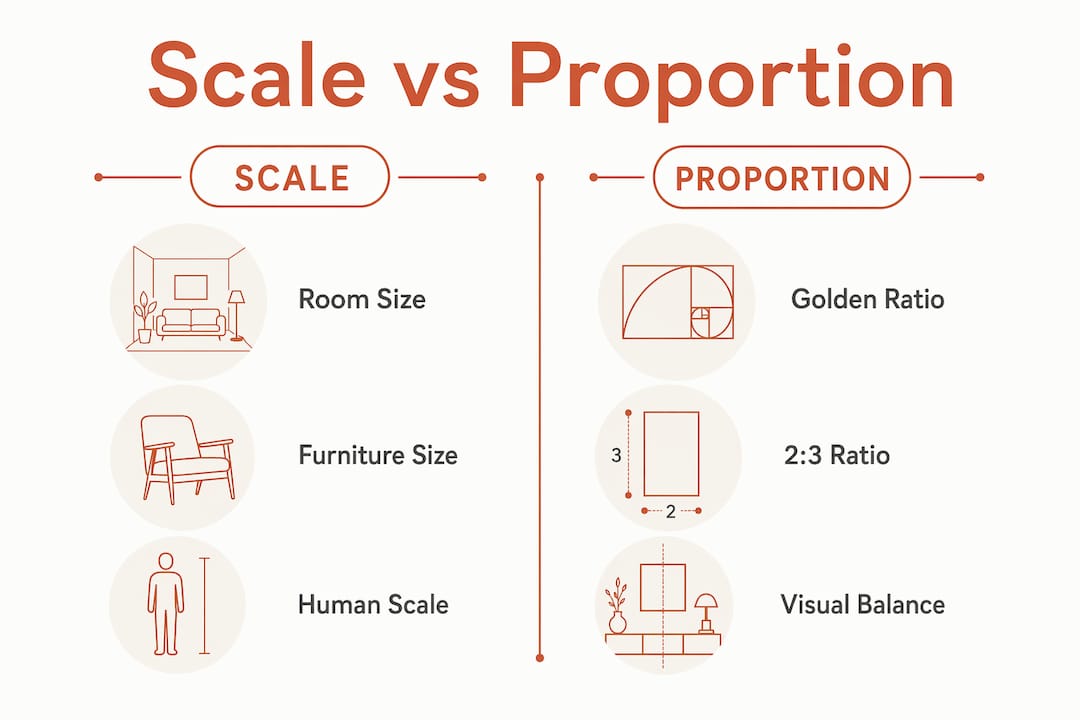
The simpler 2:3 ratio works just as well for everyday decisions. A lamp on a side table should stand roughly 1.5 times the height of the table itself. A headboard should be roughly two-thirds the width of the bed frame. These ratios are not rules that punish deviation. They are starting points that explain why certain combinations feel right.
| Proportion ratio | Common application | Visual effect |
|---|---|---|
| 1:1.618 (Golden Ratio) | Mirror width to console length | Balanced, classical |
| 2:3 | Lamp height to table height | Grounded, natural |
| 1:1 | Matching nightstands | Symmetrical, formal |
| 3:5 | Rug length to sofa length | Layered, defined |
Pro Tip: Good proportion within a piece does not guarantee good scale in the room. Evaluate both separately. A beautifully proportioned armchair can still be too large for a small reading nook.
What are practical furniture size guidelines and clearance requirements?
Concrete measurements turn design principles into decisions you can act on. Clearance standards give you the minimum space needed for comfort and safe movement through a room.
The core clearance numbers every homeowner should know:
- Primary walkways: 36 inches minimum. This is the path from the entry to the main seating area or kitchen.
- Secondary pathways: 24 inches minimum. Side routes between furniture pieces.
- Sofa to coffee table: 14–18 inches. Close enough to reach a drink, far enough to cross your legs.
- Behind dining chairs: 36 inches. This accounts for pulling a chair out fully and standing up without hitting a wall or sideboard.
Seating areas should occupy 15–25% of total room square footage to maintain comfort and avoid overcrowding. For a 200-square-foot living room, that means 30–50 square feet of seating footprint. A standard three-seat sofa covers roughly 24 square feet on its own, leaving room for one or two accent chairs within that range.
The 2/3 wall rule applies to rugs as well. A rug in a seating area should extend at least 18 inches beyond the sofa on each side. A rug that is too small floats under the coffee table and makes the seating group look unanchored.
Follow these steps when measuring for a new furniture purchase:
- Measure the room’s full length and width. Record ceiling height.
- Mark all fixed architectural features: doors, windows, radiators, and outlets.
- Calculate 66% of the wall where the anchor piece will sit.
- Lay painter’s tape on the floor in the furniture’s exact footprint.
- Walk the primary and secondary paths. Confirm 36 inches and 24 inches of clearance.
- Measure the tightest point on the delivery route. No fixed standard exists for furniture dimensions across manufacturers, so a three-seat sofa can range from 72 to 96 inches wide. Verify every piece against your hallway and doorway widths before ordering.
Common challenges and mistakes in applying furniture scale and proportion
The most frequent mistake homeowners make is buying furniture based on showroom appeal. Showroom settings mislead buyers because large open floor plans hide how oversized a piece will feel in a real room. A sectional that looks modest in a 2,000-square-foot showroom can consume an entire apartment living room.
Delivery path dimensions cause the second most common sizing error. Many buyers measure the room correctly but forget to measure the hallway, stairwell, or elevator. A sofa that fits the living room perfectly may not fit through a 28-inch apartment doorway.
“Circulation paths of at least 36 inches are a design priority that overrides even ideal furniture dimensions.” — Furniture Traditions
Matching sizes across all furniture pieces creates clutter rather than balance. A room where every piece is the same height and visual weight feels flat and busy at the same time. Mixing anchor pieces with smaller supporting elements creates the hierarchy that makes a room feel intentional. One large sofa, two medium chairs, and one low coffee table read as a composed grouping. Four identical chairs read as a waiting room.
Ignoring proportion within individual pieces compounds scale errors. A dining table with legs that are too thin for its top looks unstable, even if the table dimensions fit the room perfectly. Train yourself to evaluate each piece on its own proportions before placing it in the room context.
How to apply furniture scale and proportion when planning your room layout
Start with an accurate floor plan. Measure every wall, note every door swing and window sill height, and mark any fixed elements like built-in shelving or radiators. A floor plan drawn to scale on graph paper, or built in a free tool like Roomstyler, lets you test furniture arrangements without moving a single piece.
Identify your anchor piece first. In a living room, that is usually the sofa. In a bedroom, it is the bed. Place the anchor piece relative to the room’s focal point, whether that is a fireplace, a window, or a television wall. Everything else scales down from there.
- Choose supporting pieces that are visually lighter than the anchor. A linen accent chair reads as lighter than a leather sectional even at the same dimensions.
- Keep at least one low horizontal surface, such as a coffee table or bench, to balance vertical furniture like bookcases or tall lamps.
- Group furniture to define zones. A rug anchors a seating zone. A pendant light anchors a dining zone. Clear zones prevent a room from feeling like a furniture showroom.
- Plan circulation paths before finalizing placement. The 36-inch primary path is non-negotiable.
- If you are fitting fitness equipment into a living space, the same scale rules apply. A guide on blending fitness equipment with home decor walks through how to maintain visual balance when workout gear shares a room with living furniture.
Revisit your painter’s tape layout after 24 hours. Living with the marked footprint for a day reveals whether the space feels right before any money changes hands.
Key takeaways
Correct furniture scale and proportion require measuring both the room and the relationships between pieces, using the 2/3 rule, Golden Ratio, and clearance standards as your baseline.
| Point | Details |
|---|---|
| Define scale and proportion separately | Scale relates furniture to the room; proportion relates parts of furniture to each other. |
| Apply the 2/3 rule | Major furniture pieces should cover about 66% of the wall they anchor. |
| Use clearance standards | Keep 36 inches on primary paths and 14–18 inches between sofa and coffee table. |
| Limit seating area footprint | Seating should occupy 15–25% of total room square footage to avoid overcrowding. |
| Verify delivery dimensions | Measure hallways and doorways before ordering; no universal furniture size standard exists. |
Why scale and proportion changed how I see every room
The first time I walked into a client’s living room and immediately felt something was off, I could not name it right away. The furniture was beautiful. The colors worked. But the room felt tense. It took me about 30 seconds to realize the sofa was 96 inches wide on a 10-foot wall, leaving less than 6 inches of breathing room on each side. The room was not ugly. It was just breathless.
That experience taught me something I now tell every homeowner I work with: your eye registers scale before your brain does. You feel a room before you analyze it. When scale is wrong, the discomfort is physical, not just visual. You hesitate at the doorway. You feel reluctant to sit down. You leave the room faster than you should.
Proportion errors are subtler but equally damaging. A dining table with a top that is too thick for its legs looks like it might collapse. A bed with a headboard that is too short for the ceiling height makes the ceiling feel lower than it is. These are not dramatic mistakes. They are quiet ones that accumulate into a space that never quite feels finished.
My honest advice is this: measure twice, tape once, and buy after you have lived with the tape for a day. The Golden Ratio and the 2/3 rule are not design school abstractions. They are shortcuts to decisions your eye would eventually reach on its own. Using them just gets you there faster, with less regret and fewer returns.
If you are planning a home gym corner or a living room that doubles as a workout space, scale matters just as much there. A well-designed home gym layout follows the same clearance and proportion logic as any other room. The principles do not change because the furniture does.
— Brian Dunn, Couch & Dumbbells
Well-scaled furniture, ready to shop at Couchanddumbells
Knowing your measurements is only half the work. Finding furniture that actually fits those measurements is the other half.
Couchanddumbells curates a range of home and interior pieces selected with real room dimensions in mind. Whether you are anchoring a living room with a statement sofa or layering in accent chairs and storage, the Home & Interior collection gives you well-sized options across styles and room types. Each piece is chosen for quality and proportion, so you spend less time second-guessing and more time enjoying a space that genuinely works for you.
FAQ
What is the difference between scale and proportion in furniture?
Scale measures how furniture size relates to the room and the people in it. Proportion measures the mathematical relationship between parts of a furniture piece or between multiple pieces in a grouping.
What is the 2/3 rule in furniture layout?
The 2/3 rule states that major furniture pieces should occupy approximately 66% of the wall they anchor. A sofa on a 12-foot wall should be roughly 8 feet wide or less.
How much clearance should I leave around furniture?
Primary walkways need at least 36 inches of clearance. Secondary paths need 24 inches. Leave 14–18 inches between a sofa and coffee table, and 36 inches behind dining chairs for comfortable pull-out space.
How do I use the Golden Ratio for furniture placement?
The Golden Ratio of 1:1.618 guides proportional relationships. Divide the longer dimension of a furniture piece or wall by 1.618 to find the ideal size for a paired element, such as a mirror width relative to a console table length.
How much of a room should seating furniture occupy?
Seating areas should cover 15–25% of total room square footage. For a 200-square-foot living room, that means a seating footprint of 30–50 square feet, including the sofa and any accent chairs.
Recommended
- The Role of Vertical Space Interiors: a Homeowner’s Guide | Couch & Dumbbells
- Home Decor Checklist for New Homeowners: 2026 Guide | Couch & Dumbbells
- How Indoor Outdoor Living Works: a Homeowner’s Guide | Couch & Dumbbells
- Why City Living Demands Versatile Furniture: a Practical Guide | Couch & Dumbbells