
A home gym equipment checklist is defined as the prioritized sequence of gear, flooring, and space requirements that enables safe, effective strength and fitness training at home. The right checklist starts with clear floor space and protective flooring, then builds outward to a barbell, power rack, adjustable bench, and versatile accessories. Skip the guesswork of buying whatever looks good online. A well-ordered fitness equipment list saves you money, protects your floors, and creates a space you will actually use every week.
1. What your home gym checklist must include first
The foundation of any home gym equipment checklist is not a machine or a gadget. It is open, protected floor space. Rubber flooring and clear space are the first requirements before any heavy equipment arrives, because home floors are vulnerable to dropped weights, moisture, and vibration. Getting this right from day one prevents costly repairs and keeps your training area safe.
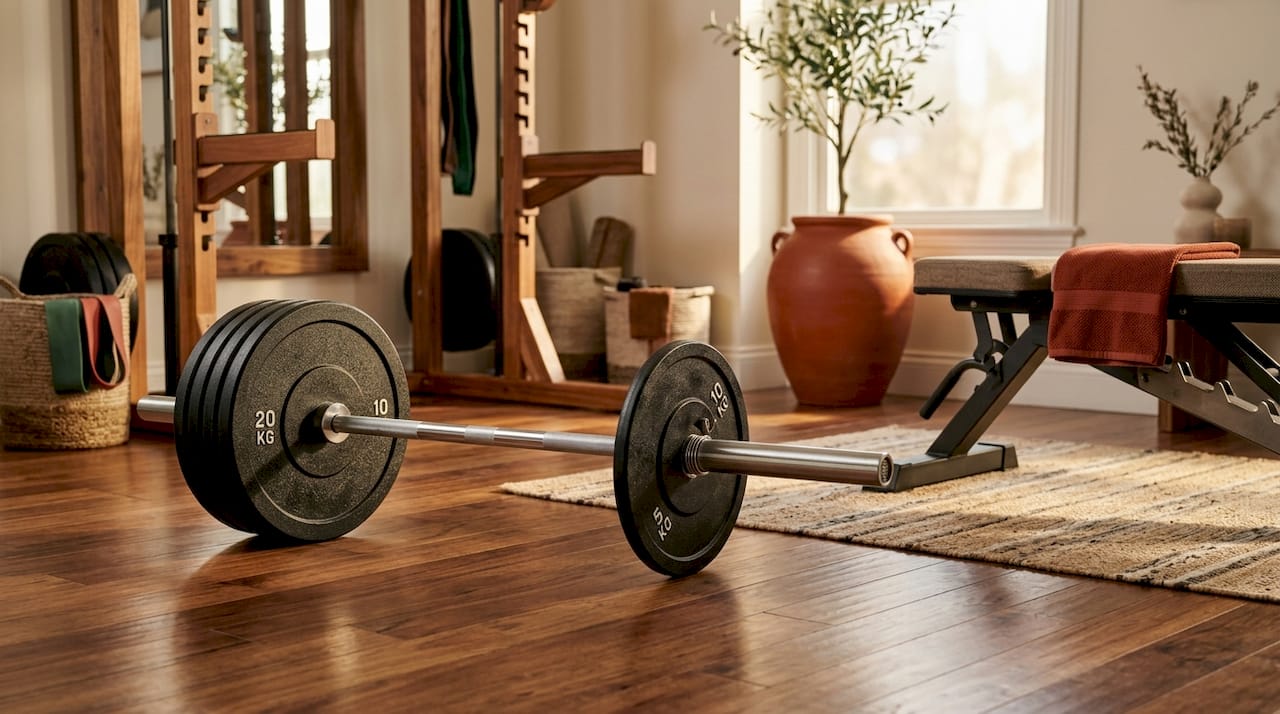
Once your floor is protected, the core strength setup takes priority. Most effective home gym setups prioritize a barbell, squat or power rack, weight plates, and an adjustable bench before anything else. These four items unlock the majority of strength training movements a person needs for months of consistent progress. Everything else on your home fitness equipment list builds on this base.
Pro Tip: Write your checklist in purchase order, not wish-list order. Knowing what to buy first removes decision fatigue and keeps your budget on track.
2. Flooring and space protection
Rubber stall mats or EVA foam puzzle mats with a thickness of half an inch to three-quarters of an inch are the recommended standard for home gym flooring. This thickness absorbs impact from dropped weights, reduces noise transmission to lower floors, and gives you stable footing during lifts. Skipping this step and training on hardwood or tile is a risk not worth taking.
Rubber flooring also defines your workout zone visually, which matters more than it sounds. A clearly bounded space signals to your brain that this area is for focused training, and that mental cue supports consistency. Budget around $1.50 to $2.50 per square foot for quality rubber mats, and cover at least the area directly under your rack and barbell.
3. Power rack or squat rack
A power rack is the single most important structural piece of your home gym. Power racks surround the lifter with adjustable safeties and carry weight capacities of 700 to 1,000 pounds, enabling heavy squats, bench presses, and overhead presses without a spotter. For anyone training alone at home, this is not optional. It is the infrastructure that makes progressive overload possible and safe.
A squat rack or half rack costs less and takes up less space, but offers fewer safety features. If your ceiling height allows and your budget permits, a full power rack from brands like Rogue Fitness or Rep Fitness gives you the most training versatility. The rack is the anchor of your entire setup, so choose it carefully and measure your ceiling clearance before ordering.
4. Barbell and weight plates
A standard Olympic barbell and a set of weight plates let you perform 40 or more exercises including squats, deadlifts, bench presses, rows, and overhead presses without needing additional machines. That range of movement is enough for a complete, months-long strength program. No other single piece of equipment delivers that much training value per dollar.
Start with a 45-pound Olympic barbell and enough plates to cover your current working weights plus room to progress. Bumper plates made from rubber are worth the extra cost if you plan to do any Olympic lifting or if your flooring is not fully padded. A beginner gym equipment guide will almost always list the barbell and plates as item one for good reason.
5. Adjustable weight bench
An adjustable bench expands your barbell work into incline and decline pressing, seated dumbbell exercises, step-ups, and more. A flat bench alone limits your range of motion options, so spending a little more for an adjustable model pays off quickly. Look for a bench with a weight capacity above 600 pounds and a stable, non-slip base.
The bench also doubles as a box for plyometric work and a support surface for single-arm rows. Brands like REP Fitness and Rogue offer adjustable benches that hold up under daily use without wobbling. Position it inside your rack footprint to save floor space.
6. Versatile accessories that expand your training
Once your strength foundation is in place, a focused set of accessories rounds out your home workout equipment essentials without crowding the room. The best choices are multi-use, compact, and complement the barbell work you are already doing.
- Adjustable dumbbells: Selectorized models like Bowflex SelectTech adjust quickly across a broad weight range and replace an entire rack of fixed-weight pairs. They are the most space-efficient dumbbell solution for home gyms.
- Resistance bands: Bands serve warm-up, mobility, and rehabilitation work. They are joint-friendly, take up almost no space, and add useful variety to pressing and pulling movements.
- Kettlebells: A single 35-pound or 53-pound kettlebell enables swings, Turkish get-ups, goblet squats, and carries. These dynamic movements train the whole body in a small footprint.
- Pull-up bar: Pull-up bars train grip, back, and arm strength with zero floor space. Mount one on a strong door frame or wall-mount it inside your rack for daily use.
- Wall mirror: A mirror is not vanity. It gives you real-time feedback on form during squats, presses, and kettlebell work, which reduces injury risk and speeds up skill development.
Pro Tip: Buy one kettlebell at a weight you will use for swings, not the lightest one available. Most people underestimate how quickly they progress past a 20-pound bell.
7. How room size and layout shape your checklist
Room dimensions determine what you can safely buy and where it goes. Measuring usable active footprint is the critical step most people skip. Active footprint means the space taken by the equipment itself plus the full range of movement you need while using it. A power rack that fits on paper may leave no room to load plates or step back for a deadlift.
Measure length, width, and ceiling height before purchasing anything larger than a dumbbell. A standard power rack needs roughly 4 feet by 4 feet of floor space, but you need at least 2 additional feet on each side for safe loading and movement. Ceiling height should be at least 8 feet for overhead pressing inside the rack.
| Room size | Recommended setup | Notes |
|---|---|---|
| Under 100 sq ft | Barbell, plates, wall-mounted pull-up bar, resistance bands | Skip the rack; use a wall-mounted barbell holder |
| 100 to 150 sq ft | Half rack, barbell, bench, adjustable dumbbells | Foldable bench saves space when not in use |
| 150 to 250 sq ft | Full power rack, barbell, bench, dumbbells, kettlebells | Room for a small cardio machine if needed |
| Over 250 sq ft | Full setup plus cable machine or functional trainer | Space for dedicated cardio and stretching zones |
Buying before measuring leads to wasted purchases and equipment that ends up in storage. Accurate measurements are not a formality. They are the difference between a gym you use daily and one that collects dust. For smaller spaces, check out apartment gym essentials for layout ideas tailored to tight rooms.
Pro Tip: Use painter’s tape on the floor to mock up the footprint of any large equipment before you order it. Walk around it, simulate loading plates, and confirm the space works.
8. Budget and purchase sequence strategy
Starter home gyms built in stages typically cost between $500 and $1,200 for a fully functional setup. That range is achievable when you follow a deliberate purchase sequence instead of buying everything at once. The sequence matters because each item builds on the last.
Follow this order when creating your home gym checklist on a budget:
- Barbell and weight plates first. This single purchase unlocks the most exercises per dollar.
- Power rack or squat rack next. Safety infrastructure makes heavier training possible alone.
- Adjustable bench before flooring if budget forces a choice. The bench multiplies your barbell exercises immediately.
- Rubber flooring once you are lifting heavier loads regularly. Protect your floors before the weights get serious.
- Adjustable dumbbells and resistance bands after the strength base is solid. These fill gaps in your programming.
- Cardio equipment last, and only if your goals require it. A jump rope or rowing machine from brands like Concept2 adds conditioning without dominating the room.
Purchasing cardio and specialty machines before securing free weights and a rack is the most common and costly home gym mistake. Specialty equipment feels exciting to buy, but it cannot replace the training value of a barbell and rack. Stick to the sequence and you will build a gym that supports real progress. For a deeper look at home gym cost breakdown, the Couchanddumbells blog covers staged purchasing in detail.
Pro Tip: Buy used barbells and plates from local gym closures or Facebook Marketplace. Quality iron holds its value and rarely wears out. Save the money for a new rack where structural integrity matters.
9. Customizing your checklist to match your goals
What to include in a home gym depends entirely on what you will actually do consistently. Training all major muscle groups twice per week with equipment you enjoy using drives better results than chasing the most advanced setup. Consistency beats complexity every time.
Define your primary training goal before adding specialty items:
- Strength and muscle building: Barbell, rack, bench, and dumbbells cover 95% of what you need. A cable machine or functional trainer from brands like Inspire Fitness adds variety once the basics are mastered.
- Cardio and conditioning: A Concept2 rowing machine, a SkiErg, or a simple jump rope delivers high-output cardio in minimal space. Treadmills and ellipticals take up significant floor area and are worth buying only if you will use them daily.
- Flexibility and mobility: A yoga mat, foam roller, and a set of resistance bands are all you need. These cost under $100 combined and support recovery alongside strength work.
- Mixed fitness: The barbell and rack foundation handles strength. Add a kettlebell and resistance bands for conditioning. This combination covers most fitness goals without overloading the room.
Revisit your checklist every six months. Training needs evolve, and the gear that serves you in month three may not be what you need in month twelve. A good gym storage system keeps accessories organized as your collection grows.
Key takeaways
A functional home gym equipment checklist starts with flooring and a barbell-rack-bench foundation, then adds versatile accessories in deliberate stages to build a safe, space-efficient training environment.
| Point | Details |
|---|---|
| Floor first, equipment second | Rubber mats protect floors and define your training zone before heavy gear arrives. |
| Barbell and rack are the core | These two items unlock the most exercises and the safest solo training possible. |
| Sequence your purchases | Buy strength essentials before accessories and cardio to maximize every dollar spent. |
| Measure before you order | Active footprint planning prevents wasted purchases and crowded, unusable spaces. |
| Match gear to your goals | Choose equipment that supports the workouts you will do consistently, not the ones that sound impressive. |
Why I think most home gym advice gets the order wrong
Most beginner gym equipment guides lead with the exciting stuff: cable machines, treadmills, smart mirrors. I get it. Those items photograph well and feel aspirational. But after seeing dozens of home gym setups that stalled or got abandoned, the pattern is always the same. People bought the wrong things first.
The gyms that get used every week share one trait: they were built around a barbell and a rack. Everything else came later, after the lifter understood what they actually needed. Adjustable dumbbells and resistance bands are genuinely underrated. They sit in a corner looking modest, but they fill more programming gaps than most people expect.
The other thing I have seen derail good intentions is skipping the measurement step. A rack that does not fit comfortably is a rack you will resent. Tape the floor, walk the space, and confirm the layout before you spend a dollar. That ten-minute exercise has saved more home gym builds than any equipment recommendation I could make.
The best home gym is not the most expensive one or the most fully equipped one. It is the one that fits your space, matches your goals, and makes you want to show up. Build it in that order and you will not go wrong.
— Brian Dunn, Couch & Dumbbells
Gear up your space with Couchanddumbells
At Couchanddumbells, we believe your workout space should feel as good as it looks. Whether you are building your first home gym or refining an existing setup, the right gear makes every session more intentional and more enjoyable.
Browse our fitness and gear collection for equipment suited to home training at every level. From portable fitness tools to space-saving accessories, each product is chosen with quality and real-world usability in mind. Explore our home and interior collection to find storage solutions, flooring options, and decor that integrate seamlessly with your training space. A gym that fits your home and your lifestyle is a gym you will keep using.
FAQ
What is the first item to buy for a home gym?
A barbell and weight plates are the first purchase for any home gym. This single setup enables over 40 exercises and supports months of strength training before any additional equipment is needed.
How much does a starter home gym cost?
A functional starter home gym typically costs between $500 and $1,200 when purchased in stages. Beginning with a barbell, plates, and rack keeps the initial investment manageable while covering the most training ground.
Do I need a power rack if I train alone?
A power rack is strongly recommended for solo lifters. It provides adjustable safety bars that allow heavy squats and presses without a spotter, with weight capacities ranging from 700 to 1,000 pounds.
What flooring is best for a home gym?
Rubber stall mats or EVA foam puzzle mats at half an inch to three-quarters of an inch thick are the standard recommendation. They protect floors, reduce noise, and provide stable footing during lifting.
Can I build an effective home gym in a small room?
Yes. A room under 150 square feet can support a half rack, barbell, bench, and adjustable dumbbells with careful layout planning. Measuring active footprint before purchasing any large equipment is the key step.