

Your home environment affects mindset through measurable psychological and physiological responses to your surroundings, making your living space one of the most powerful and underused tools for mental health. The physical features of your home, including light levels, air quality, clutter, and layout, directly influence your stress hormones, mood, and cognitive clarity. Research now links specific environmental factors to cortisol patterns, anxiety levels, and life satisfaction. Understanding how environment shapes mental state gives you real leverage to improve your well-being without changing anything about your personality or habits.
What key environmental factors in the home influence mindset?
Clutter is the most studied and most underestimated threat to mental clarity in the home. Clutter increases stress and anxiety, reducing focus and cognitive clarity according to psychological research. The effect is not just visual. Your nervous system processes the disorder even when your conscious mind stops noticing it.
Natural light ranks just as high in its impact on emotional well-being. A survey of 2,000 adults found that passive design elements like natural light, ventilation, and natural elements strongly predict improved emotional well-being. That finding means the architecture of your home is doing psychological work on you every day, whether you are aware of it or not.

Air quality and noise levels also shape your mental state in ways that are easy to overlook. Research shows that area deprivation and air pollution explain more than 80% of environmental contributions to depression and anxiety models. Poor indoor air quality produces a similar burden at a smaller scale, contributing to fatigue, irritability, and reduced focus.
Natural elements add a layer of protection. Homes rich in plants and greenery promote calmness and reduce stress. Even a single plant on a desk or a view of trees through a window shifts your nervous system toward a calmer baseline.
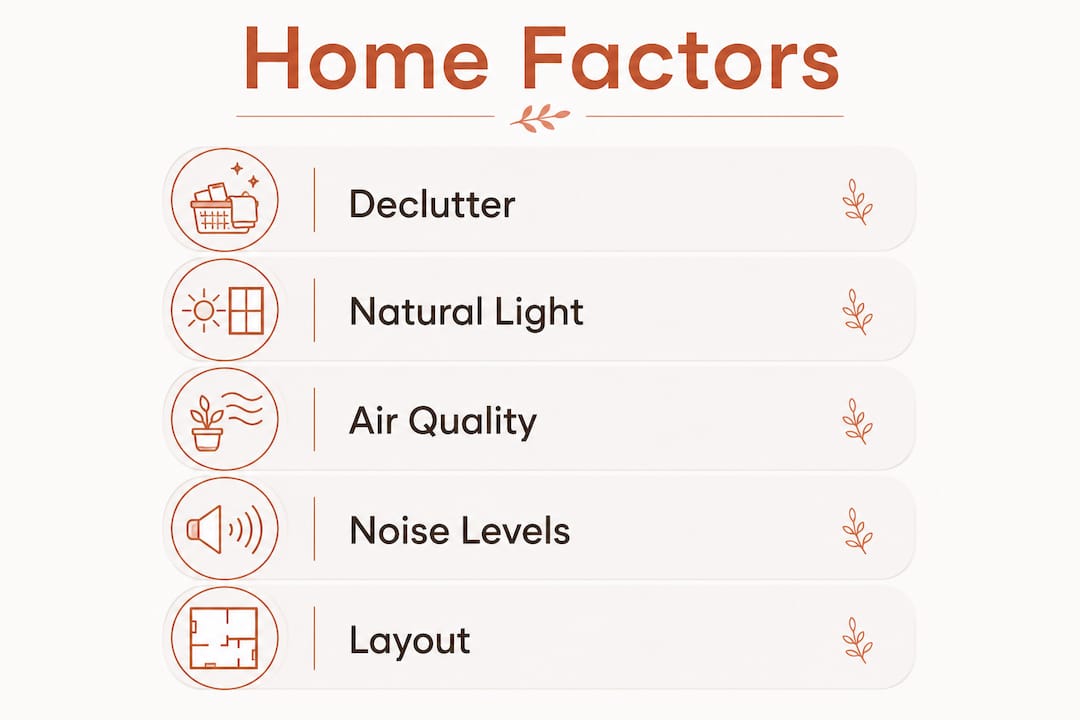
Key environmental factors that affect your mindset include:
- Clutter and disorganization: Raise cortisol and reduce cognitive clarity
- Natural light: Regulates circadian rhythms and lifts mood
- Ventilation and air quality: Reduce fatigue and support focus
- Temperature: Affects sleep quality and daily emotional regulation
- Natural elements: Plants and greenery lower stress and promote calm
- Noise levels: Chronic background noise raises anxiety and disrupts concentration
How does the way you describe your home reflect your mental state?
The language you use to describe your home is a direct window into your stress levels. A study with 60 dual-income couples found that those who described their homes as cluttered showed flatter cortisol slopes and poorer mood throughout the day. Couples who used words like “restful” showed healthier stress hormone patterns and better overall mood. The language is not just a reflection. It is also a signal that primes your nervous system for what to expect.
This matters because the brain habituates to clutter over time. You stop seeing the pile of mail on the counter or the tangled cables behind the desk. But habituation does not stop the nervous system from processing the cognitive load. Your brain is still working to manage the visual noise, even when you think you have tuned it out. That hidden processing drains mental energy you could use for focus, creativity, or recovery.
The practical implication is that shifting your language about your home can shift your biology. If you start describing your bedroom as “calm” and “ordered” rather than “messy” or “chaotic,” you begin priming your nervous system for a different response before you even walk through the door. This is not wishful thinking. It is the same mechanism behind cognitive reframing techniques used in behavioral therapy.
Pro Tip: Spend two minutes each morning describing your home in positive, specific terms. “My living room is bright and open” activates a different neurological response than “it’s a mess.” Pair this with one small physical change, like clearing a surface, to reinforce the shift.
What design changes can improve your home environment for better mindset?
Intentional design changes produce real mental health gains. The key is to target the factors with the strongest evidence behind them rather than making random aesthetic updates.
Declutter with purpose
Removing clutter is not about perfection. It is about reducing the cognitive load your nervous system carries all day. Start with one surface per day. The goal is to create visual rest points, areas where your eye lands and finds nothing demanding attention. This technique, sometimes called “visual anchoring,” gives your brain a genuine break.
Optimize your bedroom for sleep and recovery
Therapeutic design recommendations advise keeping bedrooms at 60–67°F and using layered warm lighting before sleep to align with circadian rhythms. These two changes alone produce measurable mental health benefits by improving sleep quality. Poor sleep is one of the fastest routes to mood disruption and reduced cognitive performance. Getting your bedroom conditions right is not a luxury. It is a baseline requirement for mental clarity.
Ambient lighting choices throughout the rest of your home follow the same principle. Bright, cool light supports alertness during the day. Warm, dim light in the evening signals your body to wind down.
Use layout to support your goals
Flexible living spaces that can shift between work, rest, and movement support a wider range of mental states throughout the day. A corner with a clear surface and good light becomes a focus zone. A chair near a window with a plant nearby becomes a recovery zone. You do not need a large home to do this. You need intentional placement.
Pro Tip: Assign one physical spot in your home to each mental mode: focus, rest, and movement. Even in a small apartment, a dedicated “focus chair” trains your brain to shift into work mode the moment you sit in it.
Here is a practical comparison of changes and their expected impact on mental state:
| Design change | Primary benefit | Effort level |
|---|---|---|
| Clear one surface daily | Reduces cognitive load and anxiety | Low |
| Add a plant to main living area | Lowers stress, promotes calm | Low |
| Set bedroom temp to 60–67°F | Improves sleep and mood recovery | Low |
| Switch to warm evening lighting | Supports circadian rhythm alignment | Low |
| Increase natural light exposure | Boosts mood and emotional well-being | Medium |
| Create a dedicated focus zone | Improves concentration and productivity | Medium |
How does home environment affect broader well-being and productivity?
The psychological effects of living space extend well beyond mood. Physical home conditions like lighting and temperature influence satisfaction across life domains including health, relationships, and work performance. Research confirms that life-domain satisfaction mediates the relationship between physical home conditions and subjective well-being. That means your home does not just affect how you feel in the moment. It shapes how satisfied you feel with your life overall.
The home also serves a recovery function that most people underestimate. The home acts as a regulatory environment where the nervous system downshifts after the social performance demands of the day. The fatigue you feel when you walk through your front door is not weakness. It is your biology releasing the composure it held all day. A home designed for recovery, with low visual noise, comfortable temperature, and natural elements, accelerates that process.
Productivity also responds directly to home design. Spaces that support mindset and fitness goals share a common feature: they reduce friction between intention and action. When your environment is organized around what you want to do, you do it more often and with less mental resistance.
Key ways home environment shapes broader well-being:
- Focus and cognitive performance: Organized, low-noise spaces reduce mental fatigue
- Relationship quality: A restful home reduces stress spillover into interactions with others
- Physical health: Temperature and air quality directly affect sleep and immune function
- Motivation: A space aligned with your goals reinforces your identity and intentions
- Recovery speed: A calm, ordered home shortens the time needed to decompress after demanding days
Key Takeaways
Your home environment shapes mindset through physical, sensory, and organizational factors that directly influence stress hormones, cognitive load, and life satisfaction.
| Point | Details |
|---|---|
| Clutter raises stress | Disorganized spaces increase cortisol and drain cognitive energy, even when you stop noticing the mess. |
| Language reflects biology | Describing your home as “restful” correlates with healthier cortisol patterns and better daily mood. |
| Passive design delivers results | Natural light, ventilation, and plants measurably improve emotional well-being, per a survey of 2,000 adults. |
| Bedroom conditions matter | Keeping your bedroom at 60–67°F with warm evening lighting aligns circadian rhythms and supports mental health. |
| Home enables recovery | Your nervous system uses home time to downshift from social demands, making home design a direct health investment. |
What I’ve learned from treating home design as a mental health tool
Most people treat their home as a backdrop. They focus on how it looks in photos rather than how it functions for their nervous system. That is a costly mistake.
The research on cortisol and home language stopped me cold when I first read it. The idea that the words you use to describe your living room are measurable in your stress hormones is not abstract. It means your home is in constant conversation with your biology. You are either designing that conversation intentionally or letting it happen by default.
The habituation effect is the part most people miss. You genuinely stop seeing the clutter after a few weeks. But your nervous system never does. I have seen this play out repeatedly: someone clears their home for a guest visit and reports sleeping better that week without connecting the two. The science of curated spaces confirms what that experience suggests. Visual order is not vanity. It is a nervous system intervention.
My honest recommendation is to stop treating home improvement as an aesthetic project and start treating it as a recovery protocol. Pick the one room where you spend the most time winding down. Get the temperature right. Add one plant. Clear the surfaces. Then notice what changes in your sleep, your mood, and your patience with others. The results will be faster than you expect.
— Brian Dunn, Couch & Dumbbells
Couchanddumbells: building a home that works for your mind
Creating a home that supports your mental state does not require a full renovation. It requires the right pieces in the right places.
Couchanddumbells curates home and interior products designed for people who take their living environment seriously. From lighting solutions that support circadian alignment to storage and decor that reduce visual clutter, every item is selected with intentional living in mind. If you spend time outdoors to decompress, the outdoor sofa patio furniture collection gives you a dedicated space to let your nervous system recover in fresh air. Your home is already shaping your mindset. Couchanddumbells helps you shape it back.
FAQ
How does home environment affect mindset directly?
Your home environment affects mindset by influencing cortisol levels, cognitive load, and circadian rhythms through factors like clutter, light, temperature, and air quality. These are measurable physiological responses, not just feelings.
Does clutter really impact mental health?
Yes. Clutter increases stress and anxiety and reduces cognitive clarity, according to psychological research. Your nervous system continues processing visual disorder even after your conscious mind habituates to it.
What is the single most effective home change for mental well-being?
Reducing clutter in the spaces where you spend the most time produces the fastest and most consistent improvement in mood and focus. Pairing that with natural light and one plant amplifies the effect.
Can the way I talk about my home affect my stress levels?
Yes. Research with 60 couples shows that people who describe their homes as cluttered display flatter cortisol slopes and worse mood. Shifting to positive, specific language about your space primes a healthier biological response.
How does home design affect productivity?
Organized, low-noise spaces reduce mental fatigue and lower the friction between intention and action. Flexible layouts that support different mental modes, such as focus, rest, and movement, produce the strongest productivity gains.