

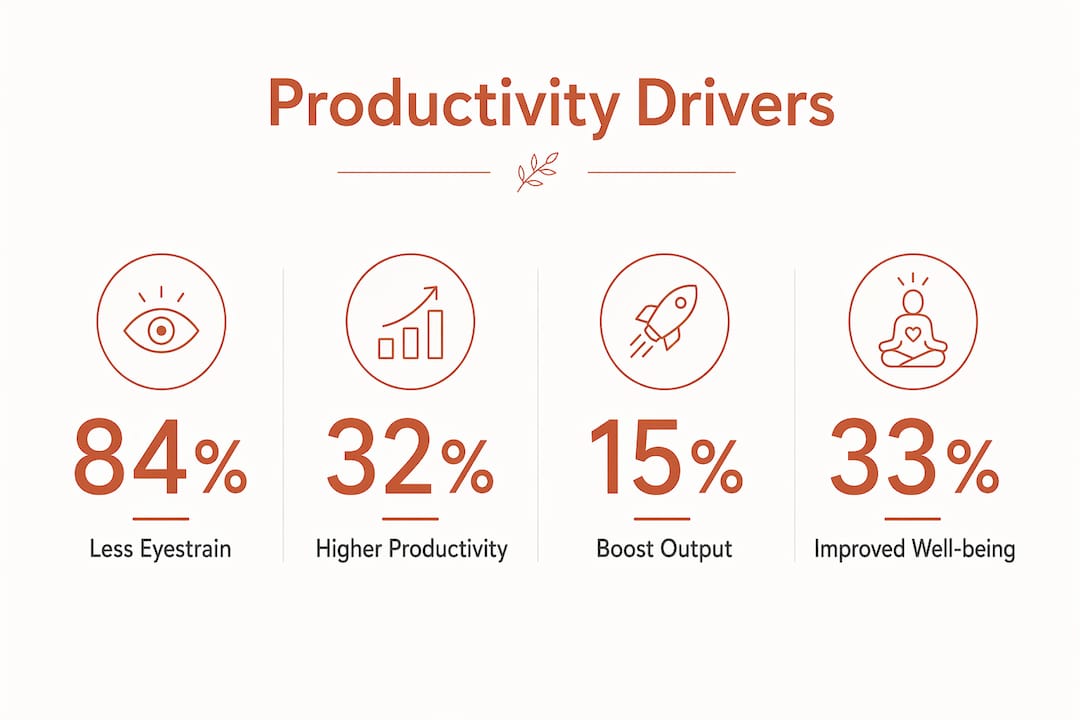
The role of home office aesthetics in productivity is direct and measurable. Your workspace design shapes your focus, mood, and output every single day. Well-designed offices yield 32% greater productivity and 33% higher well-being compared to poorly designed ones. That gap is not about expensive furniture. It is about intentional choices in lighting, personalization, organization, and sensory design that align with how your brain actually works.
How does home office aesthetics affect productivity?
Workspace aesthetics, the formal term used in environmental psychology, refers to the combined effect of visual, sensory, and spatial design on cognitive performance. The connection between aesthetic workspace productivity and output is grounded in neuroscience, not opinion. When your environment feels calm and intentional, your brain spends less energy managing distractions and more energy doing actual work. Three elements drive the most measurable results: natural light, personalized decor, and visual organization.
Ergonomics is the third pillar. A chair that supports your posture and a desk at the right height reduce physical fatigue, which directly extends your mental endurance. Remote workers who address all three elements together see compounding benefits that neither lighting nor organization alone can produce.
How does natural light improve focus and energy?
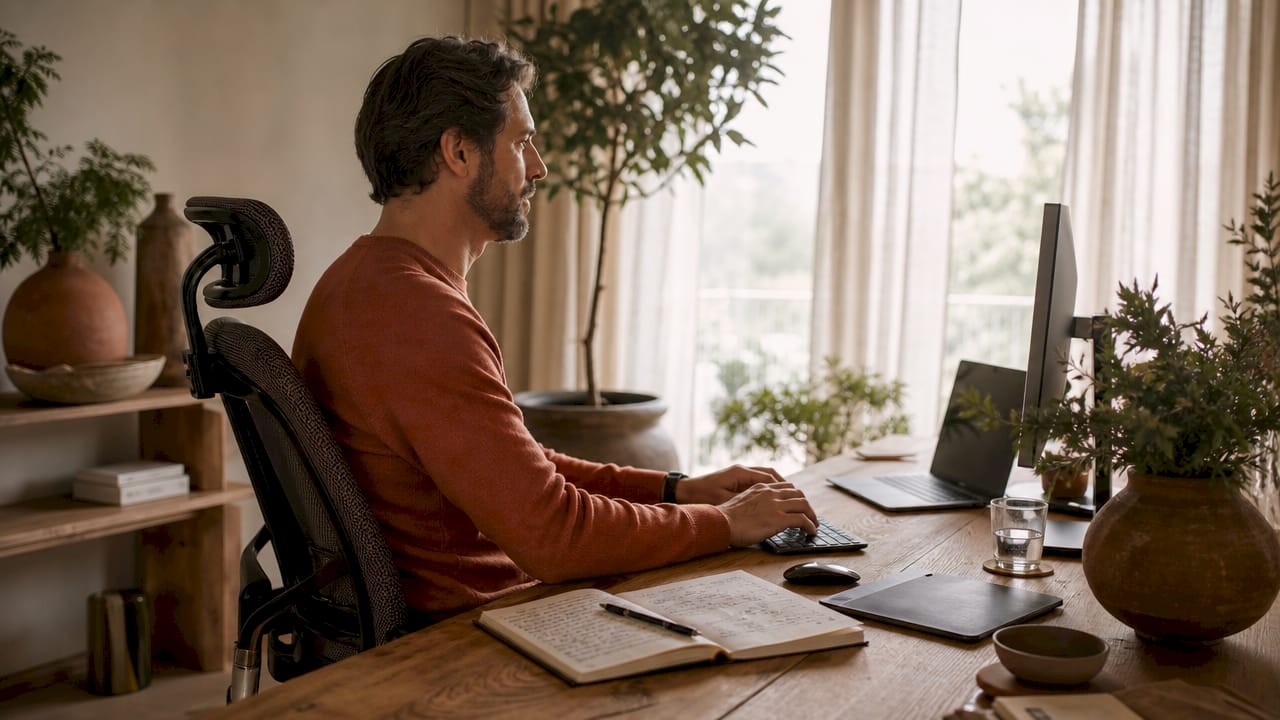
Lighting is the single most impactful variable in home office design. Daylight-optimized workstations reduce eyestrain by 84% and drowsiness by 56%, while providing 173% more white light exposure during work hours. That means fewer headaches, less afternoon fatigue, and longer stretches of clear thinking.
Position your desk so the primary window is to your side, not directly behind or in front of your monitor. Direct glare from behind creates screen reflections. Direct glare from the front causes you to squint and strain. A side-facing position gives you the benefits of natural light without the visual interference.
When natural light is limited, layered artificial lighting fills the gap effectively:
- Ambient lighting sets the overall brightness of the room and prevents harsh contrast between your screen and the surrounding space.
- Task lighting focuses on your work surface and reduces the eye effort needed for reading or writing.
- Bias lighting placed behind your monitor softens the contrast between the screen and the wall, reducing eye fatigue during long sessions.
- Color temperature matters too. Bulbs in the 5,000–6,500 Kelvin range mimic daylight and support alertness during work hours.
Lighting also regulates your circadian rhythm. Bright, cool light in the morning signals your body to stay alert. Warmer, dimmer light in the late afternoon helps you wind down naturally. Aligning your lighting with your schedule is one of the simplest ways to protect both your energy and your sleep.
Does personalizing your workspace actually boost output?
Personalization is not decoration for its own sake. Workers in enriched environments with art and plants show 15% higher productivity, rising to 32% when they have personal control over their workspace. The reason is neurological. Personalization facilitates dopamine release linked to motivation, making your own design choices more effective than any standardized setup someone else imposes.
Plants are one of the most well-documented enrichment tools. They reduce stress, improve air quality, and add a natural visual anchor that gives your eyes a resting point away from the screen. A single desk plant, a trailing pothos or a compact snake plant, is enough to shift the feel of a workspace. For a deeper look at how natural elements change a space, biophilic home decor offers practical design ideas grounded in the same principles.
Art works similarly. A print or photograph that holds personal meaning creates a visual cue that reinforces your identity and purpose in the space. The key word is personal. Generic stock art or decor chosen by someone else does not produce the same dopamine response. Research challenges one-size-fits-all design, pointing to personal agency as the real productivity advantage in home offices.
Common mistakes to avoid when personalizing your workspace:
- Choosing decor that looks good in photos but creates visual noise during work
- Adding too many personal items that compete for your attention
- Ignoring the emotional tone of colors and art when selecting pieces
Pro Tip: Pick two or three items that genuinely mean something to you, then stop. Meaningful minimalism beats cluttered personalization every time.
How does visual organization reduce mental fatigue?
Visual clutter steals working memory, and working memory is the cognitive resource you rely on for every complex task. When your desk holds objects unrelated to your current work, your brain registers each one as a potential input. That constant low-level processing drains focus before you even start your first task.
Minimalism in workspace design is a cognitive strategy, not just an aesthetic preference. Limiting the objects in your direct line of sight to what you need for the current task preserves the mental bandwidth you need for deep work. This is sometimes called the “clear desk, clear mind” principle in environmental psychology, and the neuroscience behind it is solid.
A practical organization system for your home office:
- Clear your primary work surface to only the tools you use daily. Everything else moves to drawers, shelves, or storage.
- Use vertical storage to keep items accessible without spreading them across your visual field.
- Assign a home for every object. When everything has a place, cleanup takes seconds and disorder does not accumulate.
- Apply digital minimalism to your physical space. Visible cables, charging cords, and device clutter create the same visual noise as physical objects. Cable management is not cosmetic. It is cognitive infrastructure.
- Review your setup weekly. Surfaces collect items gradually. A five-minute reset each Friday keeps the system working.
Ergonomic furniture supports this process. A desk with built-in storage and a chair with proper lumbar support reduce the physical and visual noise that accumulates when you improvise with mismatched pieces. When your furniture works with your body and your workflow, the space feels calmer and functions better.
Pro Tip: Before buying new storage, spend one week removing items from your desk rather than adding to it. You will likely find you need less than you think.
What sensory elements beyond visuals improve concentration?
Sensory elements like scent, tactile textures, and acoustic management enhance focus better than visual decoration alone. Effective home office design engages multiple brain areas, and limiting your attention to how a space looks leaves significant cognitive benefits on the table.
Scent is the most underused tool in workspace design. Rosemary is associated with improved memory retention. Peppermint supports alertness. Citrus scents lift mood and reduce mental fatigue. A small diffuser with a consistent work-hour scent can become an olfactory cue that signals your brain to shift into focus mode.
Tactile elements prevent what researchers call sensory flattening, the numbing effect of spending hours in a visually and physically uniform environment. A textured desk mat, a weighted object you can hold briefly, or a natural wood surface gives your nervous system small moments of sensory variety that maintain alertness without distraction.
Acoustic management is equally important:
- Silence is not always optimal. Many remote workers find that low-level ambient sound, around 70 decibels, supports creative and analytical work better than complete quiet.
- Noise-canceling headphones create a consistent acoustic environment regardless of what is happening in the rest of your home.
- Soft furnishings like rugs, curtains, and upholstered chairs absorb sound and reduce the echo that makes hard-surfaced rooms feel harsh and fatiguing.
- Consistent sound cues work like scent cues. Playing the same playlist or ambient sound during focused work sessions trains your brain to associate that sound with concentration.
How much does your home office environment affect yearly output?
The cumulative impact of home office design on productivity is larger than most remote workers realize. Lighting, temperature, and noise cause 5–15% variation in hourly productivity, according to Cornell University Human Factors Lab analysis. Across a full work year, that variance translates to hundreds of hours of effective work gained or lost.
Dedicated physical workspace boundaries at home improve focus, reduce interruptions, and sustain work-life balance, lowering burnout risk. A space that is visually and physically distinct from your living area sends a clear psychological signal: this is where work happens. That boundary protects both your productivity during work hours and your recovery during off hours.
“The home office is not just a place to work. It is a daily signal to your brain about what mode you are in.”
The influence of decor on work extends beyond aesthetics into identity and routine. When your workspace looks and feels like a place where serious, focused work happens, you show up to it differently. That psychological priming is one of the most underappreciated factors in remote work performance.
Key Takeaways
A well-designed home office directly increases productivity, reduces fatigue, and supports sustainable remote work through intentional lighting, personalization, organization, and sensory design.
| Point | Details |
|---|---|
| Lighting is the top priority | Daylight-optimized setups reduce eyestrain by 84% and drowsiness by 56%. |
| Personalization drives output | Personal control over decor raises productivity by up to 32% through dopamine-linked motivation. |
| Visual clarity protects focus | Limiting objects in your direct view preserves working memory for complex tasks. |
| Sensory design goes beyond visuals | Scent, texture, and acoustic management engage multiple brain areas to support flow states. |
| Boundaries protect work-life balance | A physically distinct workspace lowers burnout risk and improves psychological separation from home life. |
Why I think most home office advice misses the point
Most articles on improving productivity with design focus on what a workspace should look like. They recommend white walls, matching furniture, and a tidy desk. That advice is not wrong, but it is incomplete. The real question is not what looks good. It is what works for you specifically.
I have seen remote workers thrive in warm, art-filled rooms that would make a minimalist uncomfortable. I have also seen people do their best work at a nearly empty desk with one good lamp. The research backs this up. Personal agency over your design choices matters more than following any prescribed aesthetic. An expensive, perfectly styled setup that someone else designed for you will underperform a modest space you have shaped yourself.
The mistake I see most often is treating aesthetics as a finishing touch rather than a foundation. Remote workers spend thousands on monitors and ergonomic chairs, then work under a harsh overhead light with a cluttered desk and no sensory cues to signal focus. Flip that priority. Start with light, then clear the visual field, then add one or two personal elements that genuinely motivate you. The gear comes last.
Sensory design is the piece almost nobody talks about. Adding a consistent scent to your work sessions, managing your acoustic environment, and choosing textures that feel good to touch are not indulgences. They are the infrastructure that makes flow states repeatable. Build the sensory layer intentionally, and your workspace will do more of the cognitive heavy lifting for you.
— Brian Dunn, Couch & Dumbbells
Your home office, elevated with Couchanddumbells
A productive workspace starts with the right pieces. Couchanddumbells curates home and interior collections designed for remote workers who want their space to look intentional and perform well. From storage solutions that clear your visual field to furniture that supports both comfort and focus, every piece is selected with the same principles covered in this article.
Whether you are setting up a dedicated office room or carving out a focused corner in a shared space, the right decor and furniture make the difference between a space you tolerate and one that genuinely supports your best work. Couchanddumbells brings together style and function so you do not have to choose between them.
FAQ
How much does home office design actually affect productivity?
Well-designed offices produce 32% greater productivity and 33% higher well-being compared to poorly designed spaces. Environmental factors like lighting, noise, and temperature alone can shift hourly output by 5–15%.
What is the most important element of a productive home office?
Lighting has the largest single impact. Daylight-optimized workstations reduce eyestrain by 84% and drowsiness by 56%, making it the highest-return design investment for remote workers.
Does personalizing your workspace really improve focus?
Yes. Workers with personal control over their workspace show up to 32% higher productivity compared to those in non-personalized environments. The effect is neurological, tied to dopamine release from self-directed design choices.
How does visual clutter affect your ability to work?
Visual clutter competes directly for working memory, the cognitive resource needed for complex tasks. Keeping only task-relevant objects in your direct line of sight preserves mental bandwidth and supports sustained concentration.
Can scent and sound really improve work performance?
Specific scents like rosemary and peppermint are linked to improved memory and alertness. Multisensory workspace design that includes acoustic management and tactile variety enhances focus beyond what visual design alone can achieve.