

Online personal training is the delivery of customized fitness coaching through digital platforms, giving you expert guidance, accountability, and progress tracking without ever stepping into a shared gym. Understanding how online personal training works is the first step toward deciding whether it fits your goals, schedule, and lifestyle. When properly structured, virtual coaching produces results that match in-person training, and it costs significantly less. The progressive overload principle, bespoke program design, and consistent trainer feedback are the three pillars that make it work.
What are the main steps in the online personal training process?
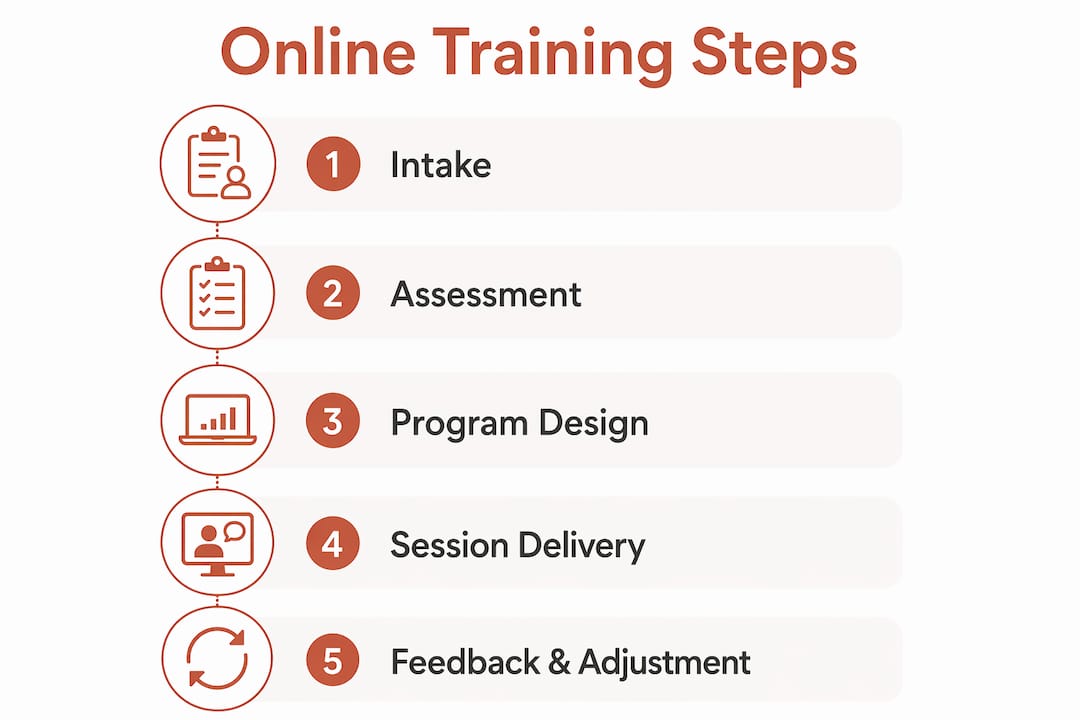
The standard online training framework follows four core steps: intake, program design, app-based delivery, and regular check-ins. Each step builds on the last, creating a structured cycle that keeps your progress moving forward.
-
Initial intake and consultation. Your trainer collects information about your goals, injury history, available equipment, and weekly schedule. This usually happens via a detailed intake form, a video call, or both. The more honest and specific you are here, the more accurate your program will be from day one.
-
Bespoke program design. Your trainer builds a workout plan tailored to your exact situation. A good trainer accounts for your equipment, time constraints, and fitness level. You can learn more about what this looks like in practice by reading about building a home workout program with equipment.
-
App-based delivery and workout logging. Your program lives inside a coaching app or shared platform. You log every session, including weights, reps, and how the workout felt. This data is the raw material your trainer uses to adjust your plan over time.
-
Asynchronous video form checks. You record short clips of key exercises and upload them for your trainer to review. Trainers provide detailed video feedback on movement quality, which delivers corrections comparable to in-person supervision for most exercises.
-
Scheduled check-ins. Weekly or bi-weekly video calls give you and your trainer a chance to review progress, address obstacles, and update the program. These check-ins are where the real coaching relationship happens.
Pro Tip: Treat your check-in like a meeting you cannot reschedule. Clients who show up prepared with questions and logged data get far more out of each session than those who join unprepared.
How effective is online personal training compared to in-person training?

The evidence is clear. Online training with real human supervision matches in-person training in improving body composition and strength, provided accountability and feedback are consistent. This is not a compromise. It is a different delivery method that produces equivalent outcomes when executed well.
The key variable is human oversight. A pre-recorded video program with no trainer interaction is not the same as online personal training. True virtual coaching includes a qualified trainer reviewing your data, watching your form, and adjusting your program based on your specific response. That human layer is what separates effective coaching from a generic workout app.
“Online training provides accountability across all 168 weekly hours, while in-person training typically covers only 2–3 hours per week. Daily trainer monitoring of habits, nutrition, and recovery delivers superior long-term behavior change potential.”
That insight reframes the comparison entirely. In-person training is intense but brief. Online coaching wraps around your whole week, which is where real lifestyle change actually happens.
The honest limitation is real-time physical correction. A trainer cannot manually adjust your posture through a screen. For beginners learning complex movements like Olympic lifts or heavy barbell work, this gap matters. Clients who are self-motivated and comfortable with data-driven feedback get the most from virtual coaching. Those who need scheduled “friction” or physical presence to stay motivated may find in-person training more effective for their personality.
What are the key benefits and challenges of online personal training?
Virtual fitness coaching offers real advantages, but it also comes with tradeoffs worth understanding before you commit.
Benefits worth knowing
- Cost. Online training typically costs $50–$300 per month, compared to $50–$150 per single in-person session. That is a 30–60% reduction in cost for consistent, ongoing coaching.
- Flexibility. You train when and where it works for you. Your living room, a hotel gym, or a park all become viable training spaces.
- Access to specialists. Geography no longer limits your options. You can work with a trainer who specializes in postpartum fitness, powerlifting, or mobility regardless of where you live.
- Whole-week accountability. Your trainer monitors your habits, sleep, and nutrition across the full week, not just during a session. That extended reach is one of the primary values of online coaching.
- Program variety. Different types of online workout programs give you options ranging from strength-focused blocks to cardio-based plans, all delivered through the same platform.
Challenges to plan for
- Self-motivation is non-negotiable. No one is physically present to push you through a hard set.
- Communication delays can slow feedback. If your trainer takes days to respond to a form video, your technique issues compound.
- Technical friction exists. Logging workouts, uploading videos, and using apps adds steps that some people find tedious.
- Beginners learning complex movements need extra patience and clear video instructions to compensate for the lack of hands-on correction.
Pro Tip: Before signing with any trainer, ask how quickly they respond to form check videos and how often they update your program. Clear expectations prevent frustration on both sides.
How do you maximize success with online personal training?
Success in virtual coaching is a two-way effort. Your trainer designs and adjusts. You execute and communicate. The partnership only works when both sides hold up their end.
-
Log every workout without exception. Your training data is your trainer’s primary tool. Missing logs leave your trainer guessing instead of adjusting.
-
Submit form check videos consistently. Even when you feel confident in your technique, regular video submissions catch drift in movement patterns before they become injuries.
-
Engage fully in check-ins. Come prepared with specific questions, honest feedback about how your body is responding, and any life changes affecting your schedule or energy.
-
Communicate obstacles early. Irregular communication leads to “communication entropy,” a gradual breakdown in coaching quality caused by sporadic messaging and missed updates. Scheduled, predictable feedback cycles outperform reactive check-ins every time.
-
Use wearable technology. Devices like Apple Watch, Garmin, and Whoop share biometric data directly with your trainer. Wearable data enhances program personalization by giving your trainer visibility into your recovery, heart rate trends, and sleep quality between sessions. A smart fitness belt is one practical option for tracking core engagement and movement data during workouts.
-
Choose a trainer who adjusts, not one who templates. True personalization comes from continuous program updates based on your stress levels, lifestyle, and specific feedback. Fixed templates delivered to every client are not coaching. They are content delivery.
-
Consider a hybrid model when needed. Occasional in-person sessions combined with ongoing online support give you hands-on form correction without sacrificing flexibility. Hybrid models are growing in popularity precisely because they balance accountability with the convenience of remote coaching.
Key Takeaways
Online personal training works best when structured feedback, consistent data sharing, and genuine program personalization replace the physical presence of a gym session.
| Point | Details |
|---|---|
| Structured process matters | Effective virtual coaching follows intake, custom programming, video form checks, and scheduled check-ins. |
| Results are equivalent | Research confirms online training matches in-person outcomes when human supervision and accountability are maintained. |
| Cost is significantly lower | Online coaching runs $50–$300 per month versus $50–$150 per single in-person session. |
| Communication drives quality | Consistent, scheduled feedback prevents “communication entropy” and keeps program adjustments accurate. |
| Client effort is the deciding factor | Self-motivated clients who log data, submit videos, and communicate openly get the strongest results. |
What I’ve learned about who online training actually serves
Online coaching is not for everyone, and I think the fitness industry undersells that point. The clients I’ve seen thrive in virtual programs share one trait: they are genuinely curious about their own progress. They log their workouts not because they have to, but because they want to understand what is working. That internal drive is what makes the absence of physical presence irrelevant.
The clients who struggle are not lazy. They are often people who need the social friction of a scheduled appointment to show up consistently. For them, the flexibility of online training becomes a liability. No one is waiting for them, so skipping a session feels low-stakes until it becomes a pattern.
I also think people underestimate how much form correction is possible through video. A skilled trainer watching a slow-motion clip of your squat can catch heel rise, knee cave, and forward lean in seconds. It is not identical to hands-on coaching, but for most intermediate clients working with standard movements, it is more than sufficient.
The hybrid model deserves more attention than it gets. Monthly in-person sessions for technique work, combined with weekly online check-ins for programming and accountability, gives you the best of both worlds without the cost of full-time in-person training. If you are on the fence, that is the format I would try first.
— Brian Dunn, Couch & Dumbbells
Your home training setup, sorted
Building a consistent workout routine at home is far easier when your equipment matches what your online trainer actually programs for you.

At Couchanddumbells, you will find a full range of fitness and exercise gear designed for home and on-the-go training. From resistance tools to performance apparel like men’s fitness pants built for full range of motion, every product is chosen to support an active, intentional lifestyle. Whether your trainer programs bodyweight circuits, resistance band work, or dumbbell progressions, having the right gear at home removes one more barrier between you and a completed session. Good equipment does not replace good coaching. It makes good coaching easier to act on.
FAQ
What is online personal training?
Online personal training is remote fitness coaching delivered through digital platforms, including apps, video calls, and messaging. A qualified trainer designs your program, reviews your form via video, and adjusts your plan based on your progress.
How does a virtual trainer correct my form?
Trainers review video clips you upload after each session and provide written or video feedback on your movement. This asynchronous process catches most technique issues for standard exercises and is comparable to in-person correction for intermediate-level clients.
Is online personal training cheaper than in-person?
Online coaching typically costs $50–$300 per month, which is 30–60% less than in-person training, where a single session often runs $50–$150. The savings make consistent, long-term coaching far more accessible.
Who gets the best results from virtual coaching?
Self-motivated clients who are comfortable tracking data, submitting form videos, and communicating openly with their trainer get the strongest results. Those who need physical presence or scheduled appointments to stay accountable may benefit more from in-person or hybrid formats.
How often should I check in with my online trainer?
Weekly or bi-weekly check-ins are the standard for effective online coaching. Consistent, scheduled reviews prevent the “communication entropy” that degrades coaching quality when contact becomes sporadic or one-sided.