

Symmetry in interior spaces is defined as the balanced distribution of visual weight across a room, creating harmony, calm, and a natural resting point for the eye. Interior designers and researchers at Homes & Gardens, The Style Saloniste, and Bark & Chase consistently identify symmetrical balance as one of the most reliable tools for producing spaces that feel both beautiful and functional. The role of symmetry in interior spaces extends beyond aesthetics. It shapes how you feel the moment you walk into a room, how easily you relax, and how well a space supports your daily routines. This guide breaks down the mechanics, the psychology, and the practical steps you need to use symmetry with confidence.
What is the role of symmetry in interior spaces?
Symmetrical balance in interior design is the visual weight equivalence between elements on either side of a central axis. The objects do not need to be identical. Two chairs of similar scale placed on either side of a fireplace achieve the same balance as two matching armchairs. What matters is that neither side feels heavier, busier, or more dominant than the other.
Three types of symmetry appear most often in residential interiors:
- Bilateral symmetry: A central axis divides the space into two mirrored halves. A sofa flanked by two identical side tables is the clearest example.
- Radial symmetry: Elements radiate outward from a central point. A round dining table with evenly spaced chairs is a classic application.
- Translational symmetry: A pattern or element repeats at regular intervals, such as evenly spaced wall sconces along a hallway.
The practical effect of symmetrical balance is order and visual comfort. Environmental psychology research consistently links balanced spatial arrangements to reduced cognitive load, meaning your brain does not have to work as hard to process what it sees. The result is a room that feels settled and easy to be in.
| Aspect | Pros | Cons |
|---|---|---|
| Visual clarity | Creates immediate order and calm | Can feel predictable if overused |
| Formality | Suits traditional and transitional styles | May feel rigid in casual or eclectic spaces |
| Ease of arrangement | Provides a clear framework for furniture placement | Limits flexibility for irregular room shapes |
| Psychological comfort | Reduces visual stress and supports focus | Excessive perfection can feel staged |
How does symmetry affect your emotional experience in a room?
The brain processes symmetry faster than almost any other visual pattern. Symmetry detection occurs within approximately 20 milliseconds of visual exposure. That speed means your emotional response to a balanced room is automatic and largely unconscious. You feel calm before you consciously register why.
Neuroscience research confirms that mirror symmetry activates specific neural pathways in the visual cortex rapidly and reliably. This early processing signals order and safety to the brain, which is why symmetrical spaces tend to feel immediately welcoming. Architects at Foster + Partners applied this principle at scale in the Changfeng mixed-use gallery, where building symmetry combined with natural light produced a coherent, calming environment within a dense urban context.
“Symmetry acts as a visual anchor. It tells the brain that the environment is organized and safe, which directly reduces the mental effort required to feel at home.”
That said, symmetry is not a universal solution. Research from the University of Padova found that forced symmetry reduces pleasantness in natural settings, and the same principle applies indoors. A room that is too perfectly mirrored can feel sterile or overly staged rather than lived-in and warm. The goal is not perfection. The goal is balance that supports how you actually use the space.
Key psychological benefits of well-applied symmetry include:
- Reduced visual stress and a lower sense of clutter
- A clearer sense of where to focus attention
- Faster relaxation when entering the room
- A feeling of intentionality and care in the space
How to use symmetry effectively in your home
The most reliable method for implementing symmetry starts with a strong central anchor and builds outward from there. You do not need a full renovation to achieve this. Small, deliberate changes create measurable results.
Follow this sequence for any room:
- Identify your focal point. Every symmetrical arrangement needs a center. In a living room, that is typically a fireplace, a large piece of art, or a media console. In a bedroom, it is almost always the bed headboard. In a dining room, it is the table itself.
- Place paired elements on either side. Matching lamps, side tables, chairs, or nightstands reinforce the axis. The pieces do not need to be identical, but they should carry similar visual weight in terms of size, color density, and texture.
- Maintain consistent spacing. Uneven gaps between paired elements undermine the sense of order. Use a tape measure if needed. Even a few inches of inconsistency reads as careless rather than intentional.
- Introduce asymmetrical accents in secondary layers. A stack of books on one nightstand, a trailing plant on one side of a shelf, or a throw pillow arrangement that is not perfectly mirrored adds personality without disrupting the foundational balance.
- Check traffic flow. Symmetrical furniture arrangements can sometimes block natural pathways through a room. Step back and walk through the space before committing to a layout.
Pro Tip: When matching lamps or side tables, prioritize scale over style. A tall, slim lamp and a shorter, wider lamp of similar visual mass will read as balanced even if they look nothing alike. Scale matching is the fastest way to achieve symmetry without buying identical pieces.
Bedrooms respond especially well to symmetrical design. Symmetry in bedrooms through a centered bed with matching nightstands and lamps creates a sense of stability that supports rest and routine. You can also apply the same logic to vertical space by hanging artwork centered above the headboard to extend the symmetrical axis upward.
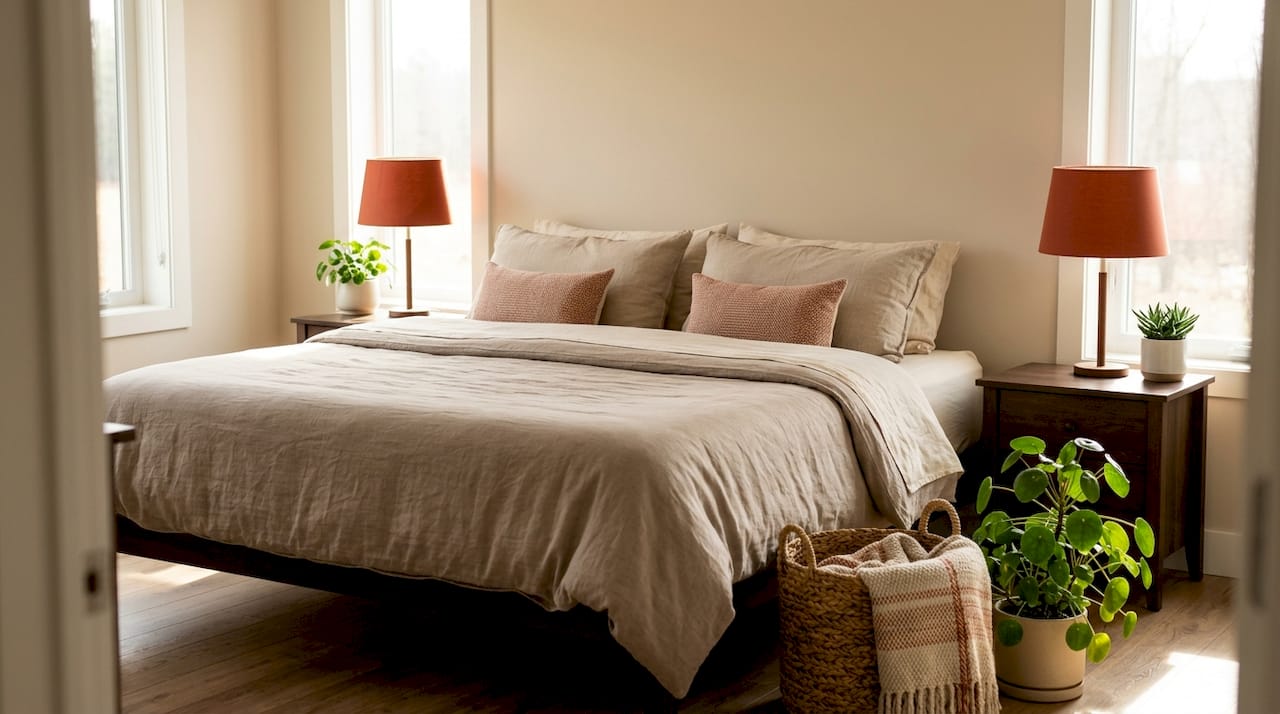
Pro Tip: In smaller rooms or apartments, symmetry is one of the most effective tools for making a space feel larger and more organized. Paired elements draw the eye across the full width of the room, which expands the perceived scale.
Symmetry vs. asymmetry: which approach works best?
Symmetry and asymmetry are not opposites in interior design. They are partners. The most engaging and livable spaces use symmetry as a foundation and asymmetry as the layer that adds energy and personal character.
Asymmetry in interior design means distributing visual weight unevenly while still maintaining overall balance. A large sofa on one side of a room can be balanced by a cluster of smaller chairs and a floor lamp on the other side. The arrangement is not mirrored, but it feels stable because the visual mass is roughly equivalent.
| Approach | Best for | Limitations |
|---|---|---|
| Symmetry | Formal rooms, bedrooms, entryways | Can feel rigid or predictable |
| Asymmetry | Eclectic, casual, or irregular spaces | Harder to execute without visual clutter |
| Blended approach | Most residential interiors | Requires more deliberate planning |
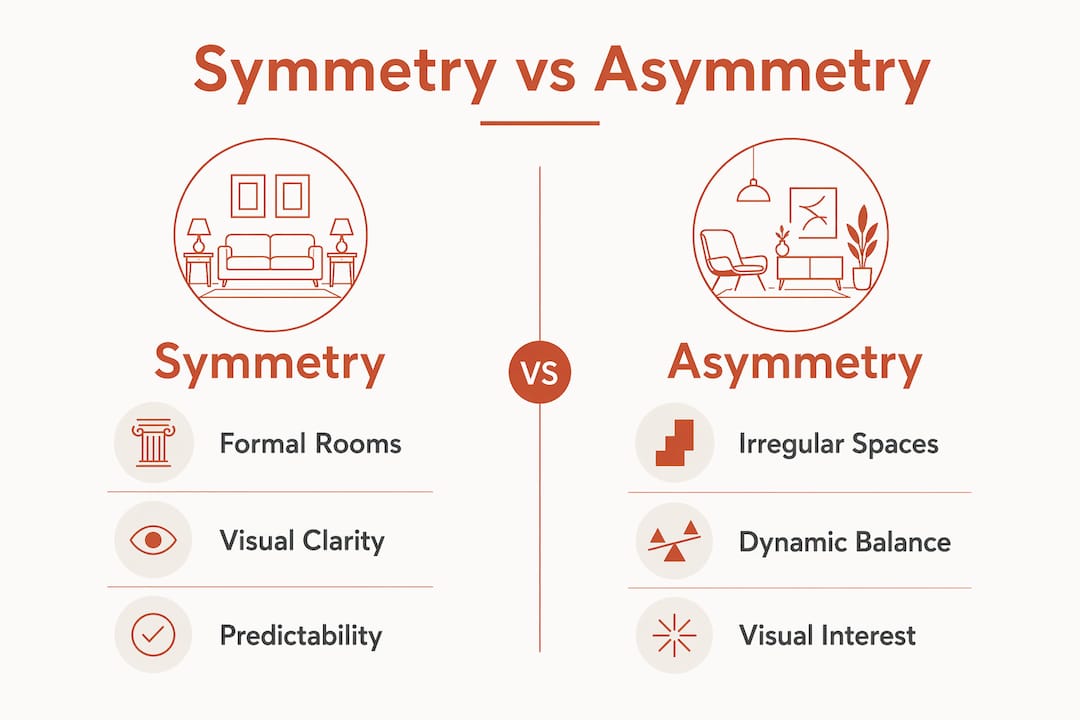
The blended approach works for nearly every home style. Start with a symmetrical backbone, such as a centered sofa facing a centered coffee table, then layer in asymmetrical details like a single oversized plant, a gallery wall that extends further on one side, or a rug placed slightly off-center. This keeps the room grounded while avoiding the static quality that excessive perfect symmetry can produce.
For irregular rooms with angled walls, alcoves, or off-center windows, asymmetry is often the more practical choice for the overall layout. You can still introduce symmetrical moments within the room, such as a symmetrically arranged reading nook or a balanced shelf display, without forcing the entire space into a mirrored structure that fights the architecture.
Blending both approaches also supports fitness and wellness spaces at home, where symmetrical storage and equipment placement creates visual order while asymmetrical accents keep the space feeling personal rather than clinical.
Key takeaways
Symmetry works best as a structural foundation combined with asymmetrical accents, not as a rigid rule applied to every element in a room.
| Point | Details |
|---|---|
| Define your central anchor | Choose one focal point per room and build all symmetrical arrangements outward from it. |
| Match visual weight, not objects | Paired elements need similar scale and mass, not identical style or color. |
| Layer in asymmetry deliberately | Add asymmetrical accents in secondary layers to prevent the space from feeling staged. |
| Symmetry affects mood directly | The brain processes balanced spaces within milliseconds, triggering calm and a sense of safety. |
| Context shapes symmetry’s appeal | Forced symmetry in casual or natural settings can reduce warmth, so apply it with intention. |
Why I think most homeowners underuse symmetry and overuse it at the same time
Here is something I have noticed after spending years thinking about how spaces feel to live in. Most people either ignore symmetry entirely or apply it so perfectly that the room loses all personality. Both extremes miss the point.
The rooms that feel genuinely good to be in almost always have a symmetrical spine. A centered bed, a balanced sofa arrangement, a fireplace flanked by matching elements. That structure gives the eye somewhere to land. Without it, even a beautifully decorated room can feel restless and hard to relax in.
But I have also walked into rooms where every single element was mirrored, and the effect was uncomfortable in a different way. It felt like a showroom, not a home. The fix is not complicated. You keep the structural symmetry and then deliberately break it in small ways. One plant instead of two. A stack of books on one side only. A throw draped casually over one arm of the sofa.
What surprises most people is how little effort the structural part actually takes. Centering your artwork above a piece of furniture, adding a second lamp to match the one you already have, pulling two chairs to face each other across a coffee table. These are not renovation-level decisions. They are afternoon decisions. And the psychological payoff, that immediate sense of calm when you walk into the room, is real and measurable.
Start with one room. Pick the focal point. Balance around it. Then add one asymmetrical detail that feels like you. That is the whole method.
— Brian Dunn, Couch & Dumbbells
Create a balanced home with Couchanddumbells
If you are ready to put symmetry to work in your home, the right pieces make the process much easier. Couchanddumbells curates home and interior collections with symmetrical design in mind, from matching lamps and side tables to coordinated decor that carries consistent visual weight across a room.
For outdoor spaces, a well-chosen outdoor furniture set creates the same sense of balance and intention outside your home as a symmetrical living room does inside. Couchanddumbells selects pieces that work together in scale and style, so you spend less time second-guessing and more time enjoying the space you have built.
FAQ
What is the role of symmetry in interior spaces?
Symmetry in interior spaces creates visual balance by distributing elements evenly around a central axis, producing calm, order, and a sense of harmony. It shapes both the aesthetic quality and the functional flow of a room.
Does symmetry have to mean identical objects on each side?
No. Symmetrical balance is about equivalent visual weight, not identical objects. Two pieces of similar scale and visual mass on either side of a focal point achieve balance even if they look completely different.
Can too much symmetry make a room feel uncomfortable?
Yes. Research from the University of Padova shows that forced symmetry reduces pleasantness when it conflicts with the natural character of a space. Rooms that are too perfectly mirrored can feel staged rather than lived-in.
What is the easiest way to add symmetry to a bedroom?
Center the bed on the main wall and add matching nightstands and lamps on each side. This single arrangement creates a strong symmetrical anchor that makes the entire room feel more settled and restful.
How do symmetry and asymmetry work together in interior design?
Symmetry provides the structural foundation and visual stability of a room, while asymmetry adds personality and energy in secondary layers. The most livable interiors use both, with a symmetrical backbone and deliberate asymmetrical accents throughout.