

Biophilic interior design is defined as an evidence-informed approach that intentionally integrates natural elements, materials, and spatial patterns into built indoor environments to strengthen human connection with nature and support psychological and physiological restoration. The term comes from “biophilia,” the innate human affinity for the natural world, a concept that architect and researcher Bill Browning and the firm Terrapin Bright Green have formalized into a practical 14 Patterns framework used by designers worldwide. This is not about placing a potted plant in a corner or choosing a green color palette. It is a purposeful, evidence-based design approach that shapes how people feel, think, and recover in the spaces they occupy every day.
What is biophilic interior design and its core principles?
The most reliable framework for understanding biophilic design comes from Terrapin Bright Green’s 14 Patterns, which organizes all biophilic elements into three distinct categories. Each category targets a different dimension of human experience in interior spaces.
Nature in the Space covers direct contact with natural elements. This includes living plants, water features, natural light, fresh air, and dynamic sensory experiences like the sound of moving water or the scent of wood. These are the most immediately recognizable biophilic elements.

Natural Analogues refers to indirect representations of nature. Think of biomorphic forms in furniture design, fractal patterns in textiles, natural materials like stone and timber, and artwork depicting natural scenes. These elements evoke nature without requiring a living organism to be present.
Nature of the Space addresses spatial configurations that mirror environments humans evolved in. Prospect spaces offer wide, open views that create a sense of safety and awareness. Refuge spaces are enclosed, sheltered areas that provide comfort and calm. Mystery and risk/peril are also included here, describing spaces that draw curiosity or a controlled sense of the unknown.
| Category | What it includes | Example in a home |
|---|---|---|
| Nature in the Space | Living plants, daylight, water, natural air | A sunlit reading nook with a living wall |
| Natural Analogues | Biomorphic forms, natural materials, fractal patterns | A stone countertop, wood-grain flooring, leaf-patterned textiles |
| Nature of the Space | Prospect, refuge, mystery, spatial variety | A window seat alcove overlooking a garden |
The key distinction here is that biophilic design principles target multi-sensory human experience, not visual decoration. A space can look “natural” and still fail to deliver any restorative benefit if it lacks sensory depth, spatial variety, or genuine connection to living systems. Bill Browning has noted that even simple elements like natural light can regulate circadian rhythms and energy levels in ways that purely decorative choices cannot.
Pro Tip: When assessing a room for biophilic potential, walk through it and ask: what do I hear, smell, and feel? If your answers are all visual, the space is under-delivering on its biophilic potential.
What does the science say about the benefits of biophilic design?
The health and wellbeing case for biophilic design is grounded in peer-reviewed research, not interior design trends. The evidence spans workplaces, homes, and healthcare settings.
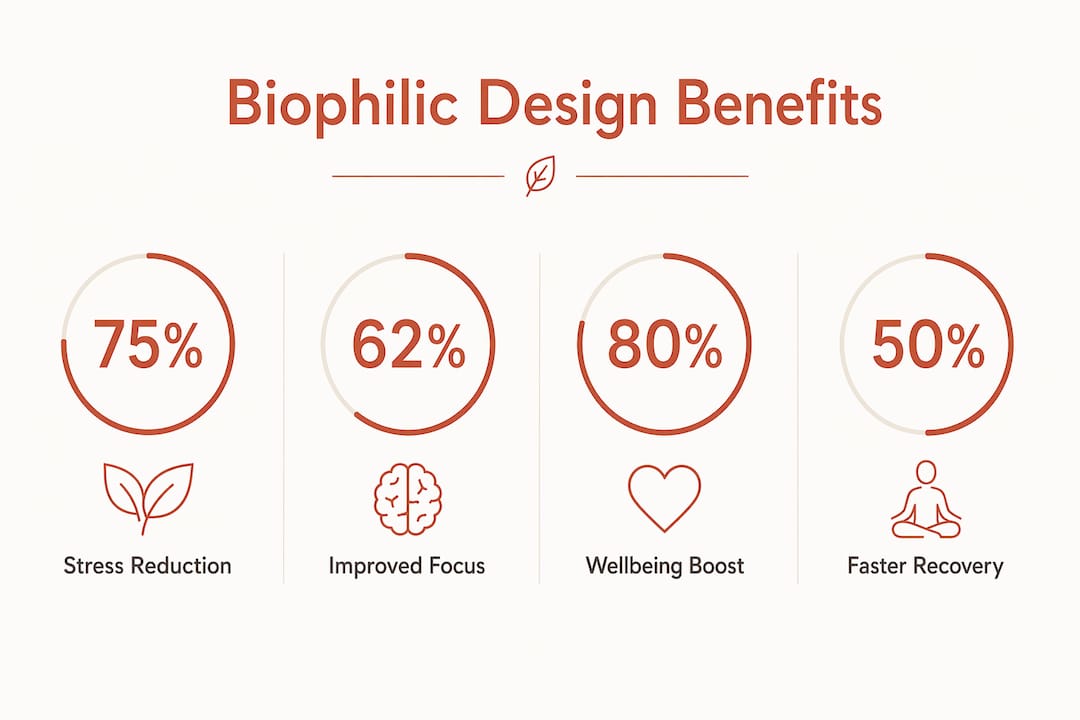
A 2024 study published in Nature Scientific Reports found that biophilic office design improves employee well-being and reduces stress, with nature relatedness acting as a key mediator. Workers with a stronger personal connection to nature experienced greater gains in vigor and job satisfaction. This means the same design intervention can produce different outcomes depending on who occupies the space, a nuance that matters for designers working across diverse client profiles.
In healthcare settings, a 2026 rapid review published in Frontiers in Public Health linked daylight and nature exposure with reduced patient agitation, faster rehabilitation engagement, and improved psychological recovery. These are measurable clinical outcomes, not subjective preferences.
A 2025 study in Scientific Reports found that brief exposure to a living wall during cognitive tasks increased physiological relaxation compared to non-natural conditions. Even a single well-placed biophilic element can shift the body’s stress response during demanding mental work.
The core benefits documented across studies include:
- Reduced cortisol levels and physiological stress markers
- Improved cognitive performance and focus
- Greater emotional well-being and mood stability
- Enhanced sleep quality through circadian rhythm support
- Faster recovery from mental fatigue
“The buildings people love have a strong biophilic component.” — Bill Browning, Terrapin Bright Green
The practical implication is clear. Biophilic design is not a luxury upgrade. It is a health-supporting design strategy with documented outcomes across multiple building types and populations.
How does biophilic design differ from sustainable design and green décor?
These three concepts are frequently confused, and the confusion leads to poor design decisions. Understanding the difference helps you apply each approach with the right intention.
Sustainable design focuses primarily on reducing environmental impact. It targets energy efficiency, material sourcing, carbon footprint, and resource conservation. Tools like LEED certification and BREEAM ratings measure sustainable performance. The primary beneficiary is the planet.
Biophilic design centers on human experience. Its goal is psychological and physiological restoration through nature connection. The primary beneficiary is the person inside the building. A space can be highly sustainable and completely devoid of biophilic quality. It can also be richly biophilic while using materials that score poorly on sustainability metrics.
Green décor is a visual style choice. Hanging a few plants, painting a wall sage green, or adding botanical prints creates an aesthetic impression of nature. It does not reliably produce the restorative outcomes that evidence-based biophilic design delivers, because it lacks the spatial, sensory, and experiential depth the research supports.
| Dimension | Biophilic design | Sustainable design |
|---|---|---|
| Primary goal | Human-nature connection and restoration | Environmental impact reduction |
| Key methods | Natural elements, spatial patterns, sensory engagement | Energy efficiency, material sourcing, waste reduction |
| Measured outcomes | Well-being, stress reduction, cognitive performance | Carbon footprint, energy use, certification scores |
| Evaluation tools | Post-occupancy surveys, occupant feedback | LEED, BREEAM, energy audits |
The most thoughtful projects combine all three. But when budget or scope forces trade-offs, knowing which goal you are serving keeps your design decisions honest. If your client wants to feel better in their home, biophilic design is the right lens. If they want a lower utility bill, sustainable design is the priority.
How to create biophilic spaces that actually work
Effective implementation comes down to one principle: layering. A single biophilic cue like one plant wall is not sufficient on its own. Combining direct nature elements, natural analogues, and spatial configurations creates a consistent and rich natural experience across different times of day and activities.
Here is a practical approach to layering biophilic design in any interior:
-
Start with light and views. Maximize natural daylight and create sightlines to outdoor greenery or sky. These are the highest-impact, lowest-cost biophilic interventions available. Rearranging furniture to prioritize window access costs nothing and delivers measurable benefits.
-
Add living elements. Introduce plants, a small water feature, or a living wall in areas where people spend the most time. For home fitness spaces, consider how nature-inspired aesthetics can make a workout area feel calming rather than clinical.
-
Choose natural materials deliberately. Stone, timber, linen, and wool engage the senses through texture and scent, not just appearance. A reclaimed wood desk or a stone tile floor contributes to biophilic quality even in a room with no plants.
-
Design for prospect and refuge. Create at least one open, view-oriented area and one sheltered, enclosed spot in each primary living zone. A window seat with a view is a prospect space. A reading nook with a low ceiling and soft lighting is a refuge space. Both serve distinct psychological needs.
-
Use post-occupancy evaluation to refine. After living or working in a redesigned space for 60 to 90 days, gather occupant feedback through surveys or structured reflection. Identify which elements feel restorative and which feel absent or underperforming. This process, known as post-occupancy evaluation (POE), is the same tool used by professional architects to validate design outcomes.
Pro Tip: Maintenance matters as much as installation. A neglected plant wall or a broken water feature actively undermines biophilic quality. Build a realistic care plan into your design from day one.
Common mistakes to avoid include swapping synthetic materials for natural-looking ones without addressing light, air, or spatial variety. A faux-wood vinyl floor does not deliver the sensory engagement of real timber. Similarly, simple material swaps without supporting spatial and sensory conditions consistently fail to produce the well-being outcomes clients expect. If you are exploring how biophilic principles apply to connected indoor and outdoor living, the indoor-outdoor living guide from Couchanddumbells covers practical strategies for extending nature connection beyond interior walls.
Key takeaways
Biophilic interior design delivers measurable well-being benefits by layering direct nature elements, natural analogues, and spatial configurations that align with human evolutionary preferences.
| Point | Details |
|---|---|
| Definition matters | Biophilic design targets human restoration through nature connection, not visual decoration or sustainability goals. |
| Three-category framework | Terrapin Bright Green’s 14 Patterns organizes elements into Nature in the Space, Natural Analogues, and Nature of the Space. |
| Science-backed benefits | Research links biophilic design to reduced stress, better cognitive performance, and faster recovery across workplaces and healthcare settings. |
| Layering is required | Single cues like one plant wall are insufficient; combining multiple patterns across sensory and spatial dimensions produces real outcomes. |
| Evaluate after implementation | Post-occupancy evaluation identifies underperforming elements and guides refinements to maximize restorative impact. |
Why biophilic design is worth taking seriously right now
I have spent years watching interior design trends cycle through aesthetics without ever asking the most important question: how does this space make people feel? Biophilic design is the first framework I have encountered that answers that question with actual evidence rather than intuition.
What strikes me most is how often the highest-impact changes are also the simplest. Repositioning a desk to face a window, adding a timber shelf instead of a painted MDF one, or carving out a low-lit reading corner can shift a room’s entire psychological character. These are not expensive renovations. They are intentional choices grounded in how humans are wired to respond to their environments.
The nuance that most articles skip is the role of nature relatedness. The same biophilic space will affect different people differently depending on their personal connection to the natural world. A designer who ignores this will wonder why their beautifully executed living wall does not seem to move certain clients. The answer is not the design. It is the relationship between the occupant and nature, and that relationship can be cultivated over time through consistent, well-maintained biophilic environments.
Urban living and hybrid work are pushing more people to spend longer hours indoors. The home design trends for 2026 reflect a growing demand for spaces that support mental clarity and calm alongside productivity. Biophilic design is not a niche specialty anymore. It is becoming a baseline expectation for spaces that genuinely support the people inside them.
My honest recommendation: start small, layer deliberately, and evaluate honestly. The research supports the approach. Your own experience in a well-designed biophilic space will confirm it.
— Brian Dunn, Couch & Dumbbells
Bring biophilic design into your home with Couchanddumbells
If this article has you thinking about how to bring more nature into your living spaces, Couchanddumbells has curated a collection built with exactly that intention. The home and interior range features furniture and decor in natural materials, nature-inspired forms, and textures that engage the senses in the way biophilic design principles recommend.
You do not need to redesign your entire home to start. A single piece chosen with intention, a timber side table, a stone-textured planter, a linen throw, can shift the sensory quality of a room in a meaningful way. Explore the full home and interior collection at Couchanddumbells to find pieces that bring genuine natural character into your space, not just the look of it.
FAQ
What is biophilic interior design in simple terms?
Biophilic interior design is the practice of intentionally incorporating natural elements, materials, and spatial patterns into indoor spaces to support human well-being and restore the connection between people and nature. It goes beyond decoration to address how a space makes you feel physically and mentally.
What are the main elements of biophilic design?
The main elements fall into three categories from Terrapin Bright Green’s 14 Patterns framework: direct nature (plants, daylight, water), natural analogues (biomorphic forms, natural materials, fractal patterns), and nature-inspired spatial configurations like prospect and refuge spaces.
Does biophilic design actually improve health?
Yes. Research published in Nature Scientific Reports and Frontiers in Public Health links biophilic design to reduced stress, improved cognitive performance, better mood, and faster recovery in both workplace and healthcare settings.
Is biophilic design the same as sustainable design?
No. Sustainable design targets environmental impact and resource efficiency. Biophilic design targets human psychological and physiological restoration through nature connection. The two approaches can complement each other but serve different primary goals.
How do I start applying biophilic design at home?
Start by maximizing natural light and outdoor views, then add living plants and natural material surfaces. Design at least one open prospect area and one sheltered refuge space in your main living zones, and evaluate how the changes feel after a few months of daily use.