

Home investment increases value by improving a property’s market appeal, functionality, and financial competitiveness through targeted renovations and responsiveness to economic conditions. Real estate appreciation, the industry term for this growth, is driven by both what you do to a property and where that property sits. According to Opendoor’s 2026 Cost vs. Value data, garage door replacements now return 268% ROI, costing under $5,000 while adding over $12,500 in resale value. That single number tells you something important: the benefits of home investment are not evenly distributed across project types. Knowing which investments move the needle, and why, is the difference between building wealth and spending money.
Why home investment increases value: the core drivers
Home value grows from two sources. The first is what you control: renovations, curb appeal, and added square footage. The second is what the market controls: local job growth, school quality, and neighborhood supply. Both matter, and the most effective homeowners work both angles at once.
The Remodeling Magazine Cost vs. Value framework consistently shows that exterior projects outperform interior remodels in pure ROI terms. Stone veneer replacement adds roughly $22,880 in resale value on an $11,000 investment, a 208% return. A mid-range kitchen remodel, by contrast, typically returns less than its cost. The pattern is clear: visible, first-impression improvements generate the strongest financial returns.

Market conditions amplify or limit what your improvements can achieve. A renovated home in a declining job market will appreciate more slowly than an unrenovated home in a city with strong employment growth. Understanding this interaction is the foundation of smart property investment.
What types of home investments yield the highest returns?
The 2026 data from Opendoor ranks exterior projects at the top of the ROI list. Here is how the leading categories compare:
| Project | Approximate Cost | Resale Value Added | ROI |
|---|---|---|---|
| Garage door replacement | Under $5,000 | Over $12,500 | 268% |
| Stone veneer replacement | ~$11,000 | ~$22,880 | 208% |
| Mid-range kitchen remodel | ~$26,000 | ~$20,000 | 77% |
| Primary bathroom remodel | ~$24,000 | ~$16,000 | 67% |
| Room addition (livable sq ft) | ~$80,000+ | Variable | Lower % |
The gap between exterior and interior projects is significant. Curb appeal improvements affect perceived value more than interior remodels because buyers form their emotional reaction to a home within the first 15 seconds of seeing it. That reaction sets the price anchor before they ever walk through the door.
Adding livable square footage, such as a bedroom or bathroom, increases absolute home value. Square footage additions generally return a lower percentage than curb appeal upgrades, though they raise the total dollar value of the property. This makes them worthwhile in markets where price per square foot is high, but less efficient in slower markets.
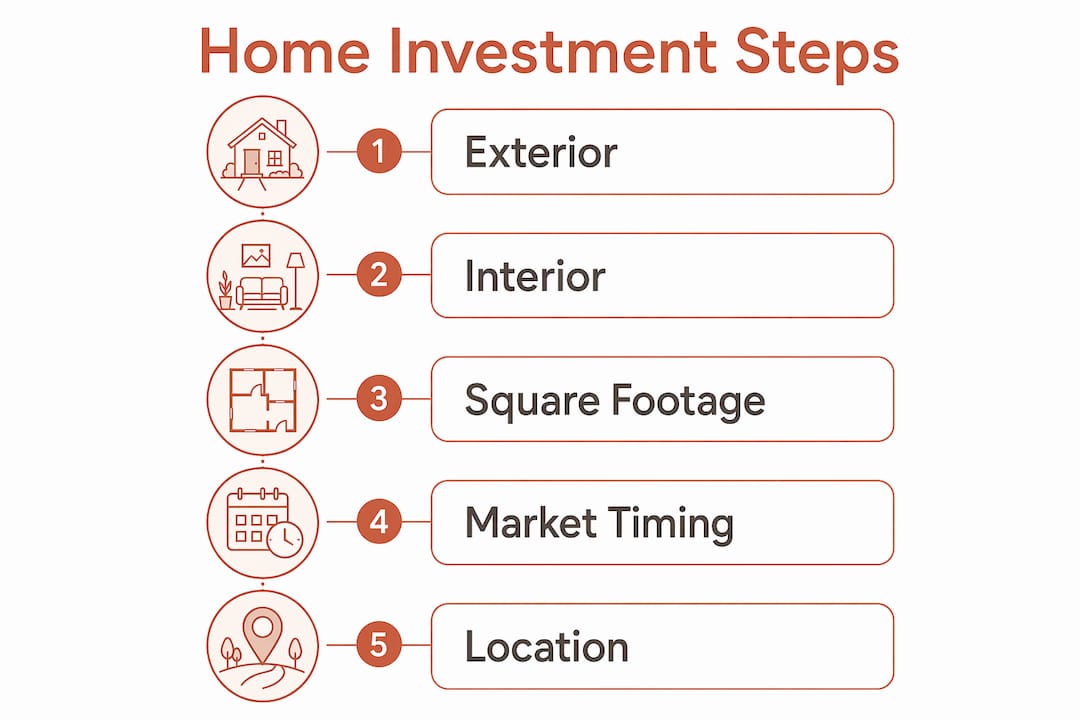
The key principle is layering. Start with high-ROI exterior projects, then move to mid-range interior updates, and only add square footage when the market supports the cost.
Pro Tip: Before any renovation, pull recent comparable sales in your neighborhood. If homes nearby are selling at $200 per square foot, a $100,000 addition that adds 400 square feet should return close to $80,000. If the math does not work, choose a different project.
How do location and neighborhood factors influence home value growth?
Location is the single most durable driver of real estate appreciation. You can renovate every room in a house, but you cannot move it to a better school district.
Homes zoned for highly rated school districts sell for 49% more than the national median. That premium exists because school quality signals neighborhood stability, which attracts a larger, more financially qualified buyer pool. More buyers competing for the same home means higher prices.
Walkability and proximity to services also shape demand. Research shows 62% of buyers consider walkability very important, and 54% prioritize proximity to services. These preferences translate directly into price premiums in urban and mixed-use neighborhoods.
Supply constraints create what real estate analysts call forced appreciation. Geographic constraints in city centers limit the supply of new homes, which pushes prices up as demand grows. Suburban areas face the opposite dynamic: builders can always add new inventory, which caps appreciation for existing homes.
“Investors should consider buying in actively developing neighborhoods before amenities are complete to capitalize on early appreciation.” This strategy, sometimes called “buying the construction trucks,” means purchasing in a neighborhood where a new park, transit line, or retail center is under construction. By the time the amenity opens, prices have already moved.
The emotional dimension of location matters too. A home near a well-maintained park or a walkable main street triggers positive associations that buyers are willing to pay for. These are real, measurable price effects, not just preferences.
What are the financial mechanics behind property appreciation?
Home investment builds wealth through several overlapping mechanisms, not just price appreciation alone.
-
Inflation and fixed-rate debt. A 30-year fixed mortgage locks your payment in nominal dollars. As inflation rises, the real cost of that payment falls. Fixed-rate mortgage paydown combined with inflation accelerates equity growth beyond what appreciation alone delivers. You are effectively paying back cheaper dollars over time.
-
Leverage. When you buy a $400,000 home with a $80,000 down payment and the home appreciates 5%, you gain $20,000 on a $80,000 investment. That is a 25% return on your actual cash, not 5%. This leverage effect is the core reason homeownership outperforms renting in nearly 80% of studied cities over a 10-year period.
-
Forced savings. Every mortgage payment builds equity automatically. Unlike a stock portfolio, you cannot easily liquidate your home equity on impulse. This constraint is actually a feature for most people. Homeownership functions as a forced savings account with tax advantages, helping owners build wealth without requiring investment discipline.
-
Costs that offset gains. Maintenance costs average 1–3% of home value annually, and transaction fees run 6–10% of the sale price. These numbers mean you need at least 5–7 years of ownership to realize a net positive financial return. Buying and selling quickly almost always destroys value.
Pro Tip: If you plan to sell within three years, prioritize low-cost, high-impact improvements like fresh exterior paint, landscaping, and updated light fixtures. Save major renovations for homes you intend to own for the long term.
How can you strategically increase your home’s value?
Strategic home improvement follows a sequence. The order matters as much as the projects themselves.
- Start with curb appeal. Garage doors, entry doors, stone veneer, and fresh landscaping deliver the highest ROI and set buyer expectations before they enter.
- Move to mid-range interior updates. Kitchen and bathroom refreshes, not full remodels, update the feel of a home without overspending. New fixtures, cabinet hardware, and countertops often return more than a full gut renovation.
- Add square footage last. Only expand when your neighborhood’s price per square foot supports the cost of construction. Over-building beyond neighborhood standards produces zero return on the excess investment.
- Avoid over-improvement. A $150,000 kitchen in a neighborhood where homes sell for $300,000 will not recover its cost. Buyers will not pay above the neighborhood ceiling regardless of interior quality.
- Time your improvements. Completing renovations 3–6 months before listing gives the market time to absorb the new value without the improvements looking dated.
The “buying the construction trucks” principle applies here too. If your neighborhood has a new transit stop or commercial development under construction, early appreciation in developing areas rewards buyers who move before the amenity opens. Timing your purchase or renovation around neighborhood growth stages is one of the most underused strategies in residential real estate.
A well-designed home gym, for example, adds both functional appeal and lifestyle value. Resources like aesthetically pleasing home gym designs show how fitness spaces can be integrated without sacrificing the visual quality that buyers respond to.
Key takeaways
Strategic home investment builds wealth through layered improvements, market timing, and an understanding of how financial mechanics like leverage and inflation work together.
| Point | Details |
|---|---|
| Exterior projects lead ROI | Garage doors and stone veneer return 200%+ and cost far less than interior remodels. |
| Location drives lasting appreciation | School district quality and supply constraints create price premiums no renovation can replicate. |
| Financial mechanics multiply gains | Fixed-rate debt, inflation, and leverage grow equity faster than appreciation alone. |
| Ownership duration matters | Plan to own for at least 5–7 years to clear transaction costs and realize net positive returns. |
| Sequence your improvements | Layer curb appeal first, then interior updates, then square footage to maximize return at each stage. |
What I have learned from watching homeowners invest
I have seen the same mistake repeated more times than I can count. A homeowner spends $60,000 on a luxury kitchen remodel in a neighborhood where the average sale price is $350,000. The kitchen is beautiful. The return is negligible. Meanwhile, their neighbor replaces the garage door, reseeds the lawn, and paints the front door for under $8,000, then sells for $15,000 more than the street average.
The interior of a home matters, but buyers decide how they feel about a property before they ever see the kitchen. That 15-second emotional reaction is real, and it is measurable in sale prices. Most homeowners underestimate this completely.
Location scarcity is the other factor people consistently overlook. I have watched properties in geographically constrained urban neighborhoods appreciate at three times the rate of suburban homes with better interiors, simply because there is nowhere to build new supply. You cannot renovate your way out of a bad location, but you can buy into a constrained one and let the market do the work.
The most grounded way to think about homeownership is as a forced savings tool with occasional upside. It is not a stock. It does not compound at 10% annually. But for most people, it is the most reliable wealth-building mechanism available, precisely because it removes the temptation to spend what you would otherwise save. Align your improvements with what the market expects, not what you personally love, and the financial returns will follow.
— Brian Dunn, Couch & Dumbbells
Make your home work harder for you
Your home is one of your most intentional investments. The right interior choices do more than look good. They signal quality, care, and lifestyle to every buyer who walks through the door.
At Couchanddumbells, the home and interior collection is built for homeowners who want their spaces to reflect both beauty and purpose. From curated furniture and storage solutions to outdoor pieces that extend your living space, every product is chosen to add real visual and functional value. If you are investing in your home, start with the spaces that buyers and guests see first. Explore the full collection and find pieces that make your home feel as good as it looks.
FAQ
Why does home investment increase property value?
Home investment increases property value by improving market appeal, functionality, and buyer perception. Exterior upgrades, interior updates, and added square footage all contribute to higher sale prices when aligned with neighborhood standards.
What home improvements have the highest ROI in 2026?
Garage door replacement leads with a 268% ROI, followed by stone veneer replacement at 208%. Exterior projects consistently outperform interior remodels in return on investment.
Does location affect home value more than renovations?
Location creates price premiums that renovations cannot replicate. Homes in top-rated school districts sell for up to 49% more than the national median, regardless of interior condition.
How long do you need to own a home to profit from investment?
Plan to own for at least 5–7 years. Maintenance costs averaging 1–3% annually and transaction fees of 6–10% require sufficient time to offset before a net positive return is realized.
Is buying a home better than renting for building wealth?
Homeownership outperforms renting in nearly 80% of studied cities over a 10-year period, primarily due to leverage and mortgage paydown. High-cost markets are the main exception, where renting can outperform by a significant margin.