

Your workspace is not overhead cost. It’s one of the most direct levers you have over how your team performs, how long they stay, and how your company grows. The evidence is clear: thoughtful investment in your physical work environment drives measurable gains in productivity, retention, and culture, while delivering a return that outpaces most other operational spending.
Here’s the bottom line before we go deeper:
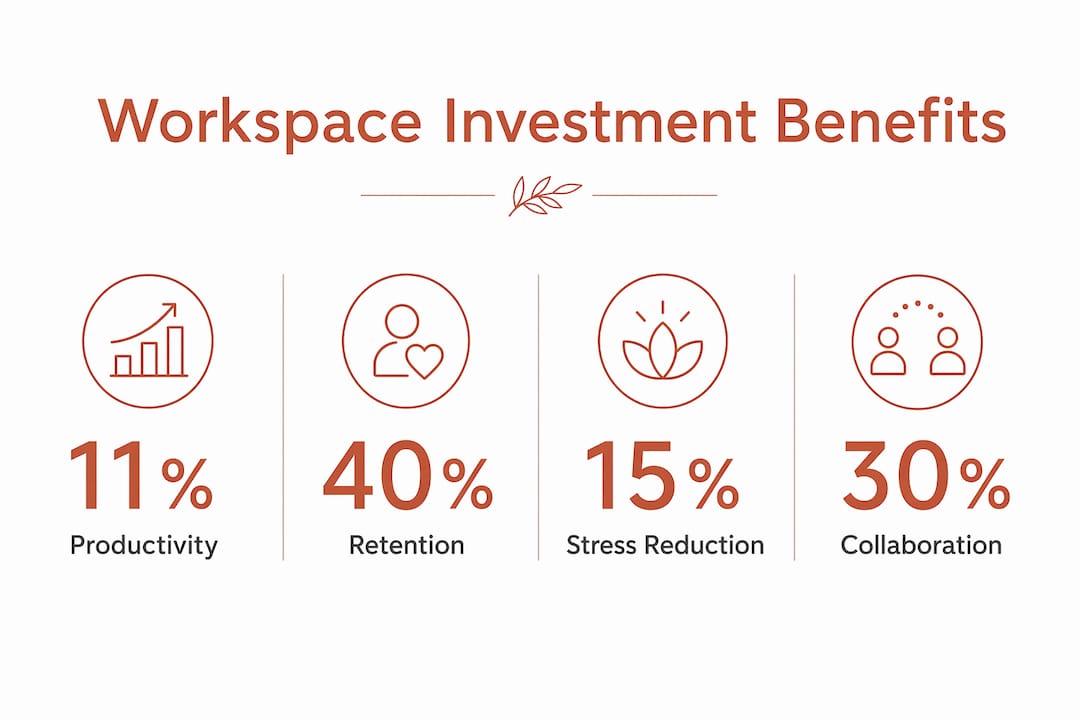
- Well-designed workplaces make employees nearly three times more likely to stay with their employer.
- Better indoor air quality alone links to productivity gains of 8–11%.
- Staff costs represent a large majority of business operating expenses, so even a small performance improvement delivers a return that dwarfs most other investments.
- Physical workspace design shapes company culture, talent attraction, and long-term financial performance, not just daily comfort.
- Leading organizations now treat workspace as strategic capital allocation, tied directly to business goals like agility and innovation.
Why investing in workspace matters: 11 evidence-based reasons
1. Workspace design directly drives productivity
Employees with real choice in where and how they work are 2.5 times more likely to say their workplace supports both individual and team output, according to Gensler’s 2025 Global Workplace Survey of over 16,000 workers across 15 countries. That’s not a marginal edge. When your team can match their environment to the task, whether that’s a quiet focus zone or an open collaboration area, deep work and creative thinking both improve.
2. Air quality and lighting have a bigger impact than most leaders realize
Better indoor air quality links to notable productivity improvements, according to World Green Building Council research. Adequate lighting, good ventilation, and thermal comfort are associated with higher employee satisfaction and engagement. These aren’t luxury upgrades. They’re the baseline conditions under which your team can actually do their best work.

3. Retention improves dramatically in well-designed offices
Replacing a mid-level employee costs six to nine months of their salary once you factor in recruitment, onboarding, and the productivity dip during the transition. Workspace design plays a direct role in preventing that cost. Employees in well-designed environments are significantly more likely to stay, and a much higher proportion of those who like their workspace say they’re proud to work for their company compared to those who feel disconnected from their environment.
4. Physical proximity accelerates collaboration and decision speed
Physical clustering reduces cycle time from idea to execution. Fewer handoffs, clearer ownership, faster decisions. For startup founders especially, this is where professional office space pays for itself. The spontaneous problem-solving that happens when your team shares a room is genuinely hard to replicate through scheduled video calls.

5. Technology integration prevents costly friction
43% of employees have cancelled meetings because suitable rooms were unavailable, according to Gensler’s 2026 Global Workplace Survey. That’s a design failure, not a scheduling problem. Smart booking systems, power-enabled furniture, and meeting rooms pre-configured for video conferencing aren’t perks. They’re infrastructure that either supports or blocks your team’s momentum every single day.
6. Biophilic design reduces stress and lifts creative output
Integrating natural elements like plants, natural light, and wood textures reduces stress by approximately 15% and boosts productivity by about 6%. For a team of 50, a 6% productivity gain effectively adds the equivalent output of three employees without increasing headcount. Biophilic design has moved from a niche architectural concept to a mainstream strategy, and the numbers explain why.
7. Workspace aesthetics and belonging predict satisfaction
Research across corporate settings consistently finds that aesthetics, flexibility, and a sense of belonging are the strongest predictors of workspace satisfaction. Spaces that reflect your organization’s values, through aligned materials, colors, and design choices, create a two-way relationship with employees. People feel seen by the space they work in, and that feeling translates into engagement.
8. Acoustic zoning protects your team’s most valuable hours
Open-plan offices are not universally productive. Without deliberate zoning, noise becomes the single biggest drain on focused work. Designated quiet areas, sound-absorbing materials in collaborative spaces, and phone booths for calls protect the deep-work hours that drive real output. Zoning strategies create varied settings that support both focused work and collaboration, which is what high-performing teams actually need.
9. Workspace ambience shapes mental health and firm performance
The World Health Organization estimates that 12 billion working days are lost every year to depression and anxiety, costing the global economy $1 trillion annually. Ambience, meaning air quality, temperature, lighting, and soundscape, is a direct lever on employee wellbeing. London Business School research confirms that firms investing in ambience reduce costs tied to anxiety and depression while improving long-term performance.
10. Inspiring environments attract top talent
Skilled candidates evaluate the experience of working with you, not just compensation. A well-run office makes onboarding smoother, helps junior staff learn by observation, and creates social connection that scheduled calls can’t manufacture. For executives and founders, workplace quality is increasingly part of due diligence, both for investors assessing a business and for candidates assessing an employer.
11. Sustainability in workspace design delivers dual returns
Green design elements like natural light, plants, and energy-efficient systems improve employee health and motivation while reducing operating costs over time. Progressive organizations embed sustainability into their workspace strategy because it delivers on both fronts: environmental responsibility and measurable performance gains. Buildings with biophilic features command 7–15% higher rental rates with lower vacancy rates compared to conventional buildings.
What does the ROI of workspace investment actually look like?
The financial case for office investment becomes clearest when you look at the numbers side by side.
“Staff costs typically account for about 90% of a business’s operating expenses. That ratio puts an uncomfortable truth in front of every business leader: even a small improvement in how your people perform delivers a return that dwarfs most other operational investments.” — World Green Building Council
The math is straightforward. If your payroll is $2 million annually and a workspace upgrade lifts performance by even 6%, that’s $120,000 in effective output gained. Compare that to the cost of a design refresh, and the investment case writes itself.
| Metric | Before workspace investment | After workspace investment |
|---|---|---|
| Retention likelihood | Baseline | Nearly 3x more likely to stay |
| Productivity from air quality | Baseline | 8–11% improvement |
| Stress levels with biophilic design | Baseline | Approximately 15% reduction |
| Meeting cancellation rate | 43% due to room unavailability | Reduced with smart booking systems |
| Employee pride in company | — | 90% (workers who like their space) |
Turnover is where the math gets most compelling. Losing a mid-level employee costs six to nine months of salary. A workspace that reduces avoidable churn, especially among early-tenure hires, can produce a return that far exceeds the cost of the design investment itself. Progressive organizations now reclassify workspace as strategic capital allocation rather than operational overhead, and investors are starting to evaluate it the same way.
How biophilic design and workspace wellbeing work together
Biophilic design is the practice of integrating natural elements into built environments: plants, natural light, wood textures, water features, and views of the outdoors. It’s grounded in the idea that humans perform better when they maintain a connection to nature, even indoors.
The research backs this up consistently. Introducing plants into office environments increases productivity by 15% while improving worker satisfaction and engagement, according to a review of 203 peer-reviewed studies published in Springer Nature. Separately, biophilic elements reduce stress by approximately 15% and boost productivity by about 6%, with air quality improvements adding another 8–11% on top.
Statistic: A laboratory VR study found that small-scale office spaces (9×9 m) achieved a 23.37% increase in economic benefits compared to larger open-plan spaces, with cognitive performance and creative thinking both improving in the more intimate setting.
Acoustic zoning works alongside biophilic elements to create a complete wellbeing environment. Quiet zones protect focus, collaborative hubs encourage idea-sharing, and buffer areas between high-traffic and focus spaces reduce the sensory overload that drains motivation. London Business School research highlights that workplace ambience is especially important for neurodivergent employees, who represent 15–20% of the global population. Designing for their needs doesn’t just support inclusion. It unlocks contributions that are genuinely hard for competitors to replicate.
Pro Tip: Start with natural lighting and low-cost plant installations before committing to expensive living walls or water features. These high-impact, low-cost biophilic elements deliver measurable wellbeing benefits and can be expanded in later phases as budget allows. You can explore biophilic interior design principles to find what fits your space and team.
Women executives and leaders managing high-performance teams often find that fitness and mental clarity go hand in hand with workspace wellbeing, reinforcing why the physical environment matters beyond the office walls.
Bring the same intentionality home
At Couchanddumbells, we believe the spaces where you work, rest, and move all deserve the same care and intention. Whether you’re refreshing a home office, a fitness corner, or an outdoor retreat, the right environment shapes how you feel and perform every day.
Explore our home and interior collection to find furniture and decor that brings purpose and calm to every room. If your workspace extends outdoors, our outdoor furniture sets are designed to make that space as functional and welcoming as any room inside.
Key Takeaways
Workspace investment is one of the highest-return decisions a business leader can make, because it directly improves the performance, retention, and wellbeing of the people who drive every other outcome.
| Point | Details |
|---|---|
| Productivity gains are measurable | Air quality improvements alone link to 8–11% productivity gains; biophilic design adds approximately 6% more. |
| Retention ROI is substantial | Well-designed offices make employees nearly 3x more likely to stay, avoiding six to nine months of salary in replacement costs. |
| Ambience affects mental health | WHO estimates 12 billion working days lost annually to depression and anxiety, costing $1 trillion globally. |
| Biophilic design pays for itself | Buildings with biophilic features command 7–15% higher rental rates and lower vacancy rates. |
| Workspace is strategic capital | Progressive organizations treat office design as capital allocation tied to productivity, agility, and long-term value. |
FAQ
Why is the workspace important for business performance?
Your workspace directly shapes employee focus, collaboration, and wellbeing. London Business School research confirms that ambience, including air quality, lighting, and soundscape, influences firm-level outcomes through its effect on how fully employees can apply their skills each day.
Are coworking spaces a good investment?
Coworking spaces can deliver strong value for startups and growing teams by reducing upfront costs while providing professional infrastructure. The key is whether the space supports the work modes your team needs, including quiet focus zones, collaboration areas, and reliable technology.
Why is investing in employees important?
Replacing a mid-level employee costs six to nine months of their salary. Workspace investment is one of the most direct ways to retain people, because employees in well-designed environments are nearly three times more likely to stay and express pride in their company.
Why do coworking spaces sometimes fail?
Coworking spaces struggle when they prioritize density over design, offering rows of identical desks with no acoustic zoning, poor air quality, or unreliable technology. Gensler’s research shows that 43% of employees have cancelled meetings due to room unavailability, reflecting a design failure that erodes the value of shared office environments.
How does workspace design affect company culture?
Workspaces that reflect an organization’s values through aligned materials, colors, and spatial design create a stronger sense of belonging and identity. Research consistently finds that aesthetics, flexibility, and belonging are the strongest predictors of workspace satisfaction and employee engagement.