

Multifunctional furniture is defined as any piece that performs two or more distinct functions within a single footprint, replacing what would otherwise require separate items. Understanding why multifunctional furniture matters starts with a simple reality: living spaces are shrinking while the demands placed on them are growing. The global multifunctional furniture market was valued at USD 15.9 billion in 2024 and is projected to reach USD 25.4 billion by 2034. That growth reflects a real shift in how homeowners and renters think about the furniture they bring into their homes.
What are the key benefits of multifunctional furniture?
68% of homeowners prioritize versatile, multifunctional furniture to maximize comfort and utility in smaller living spaces. That figure tells you something important: most people are already thinking this way, and the ones who act on it live better in less square footage.
The benefits of multifunctional furniture fall into five clear categories:
- Space recovery. A storage bed replaces both a standard bed frame and a separate dresser. An expandable dining table serves as a compact surface for two and a full dinner table for eight. You get the same utility with a fraction of the floor space used.
- Cost savings. Buying one piece that does the job of two or three costs less than buying each item separately. Over time, fewer purchases also mean fewer replacements.
- Clutter reduction. When storage is built into the furniture you already use, loose items have a natural home. Ottomans with interior storage, beds with drawers, and benches with lift tops all keep surfaces clear without adding extra furniture.
- Adaptability. Your needs change. A guest room doubles as a home office when you have a wall-mounted folding desk. A modular sofa reconfigures when you move to a new apartment. Flexible furniture moves with your life.
- Sustainable consumption. One piece serving several functions reduces the total number of items manufactured, shipped, and eventually discarded. That matters if you care about buying with intention.
Pro Tip: Before buying any new piece, write down every function you need in that zone of your home. If one item can cover two or more of those functions, it earns its place.
How is the multifunctional furniture market evolving and why?

The market is growing because the conditions driving demand are not temporary. Urban housing is shrinking, property prices are rising, and the way people use their homes has fundamentally changed.
| Driver | Impact on furniture needs |
|---|---|
| Urbanization and smaller apartments | Demand for pieces that recover usable floor space |
| Rising property prices | Pressure to do more with existing square footage |
| Short rental tenures | Preference for modular, movable pieces over built-ins |
| Hybrid and remote work | Need for furniture that transitions between work and living modes |
Approximately 30% of urban workers remain hybrid or remote, which means the home must function as an office, a gym, a dining room, and a living room, often within the same 600 square feet. That overlap is exactly what versatile furniture is built to handle.
“Multifunctional furniture, when well planned, fosters calm and intentional living by allowing spaces to transition smoothly between modes without clutter.” — 2A Magazine
Renters specifically prefer lightweight, modular pieces that can be dismantled and moved easily. With average urban rental tenures around 23 months in certain markets, heavy built-in furniture simply does not make practical sense. The market has responded with a growing category of pieces designed to be beautiful, functional, and easy to relocate.
What design mistakes should you avoid when choosing versatile furniture?
Choosing the wrong multifunctional piece is easy to do, and the mistakes tend to follow predictable patterns. Knowing them in advance saves you money and frustration.
1. Ignoring the function-to-footprint ratio
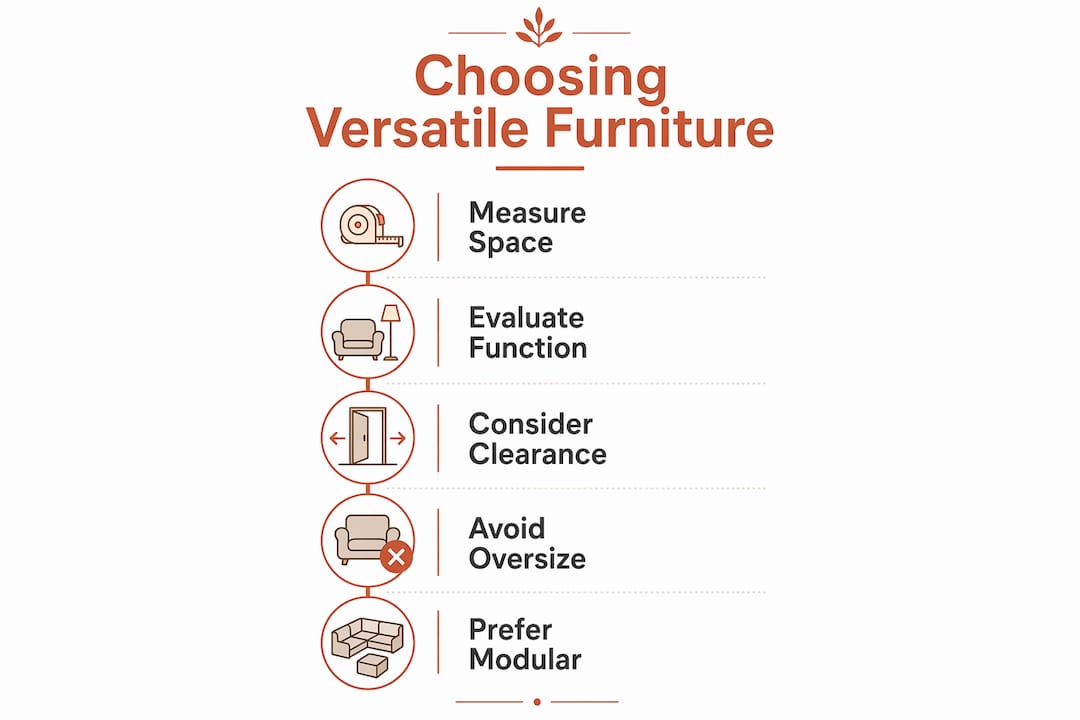
Design experts stress that the right measure for evaluating a piece is not its size alone but its function-to-footprint ratio. A large sectional sofa with built-in storage might seem like a win, but if it fills 70% of your living room floor, it eliminates the open space that makes a room feel livable. Ask yourself: how much function does this piece deliver per square foot it occupies?
2. Forgetting dynamic clearance
Measuring only the static footprint of a piece is one of the most common purchasing mistakes. An expandable dining table might measure 36 inches when closed, but it needs 60 inches when open, plus chair clearance on all sides. A folding wall desk needs clear floor space in front of it to be usable. Always measure the full operational footprint before you buy.
3. Scaling furniture from larger homes
Oversized furniture designed for larger homes reduces usability in small spaces. A king-size storage bed in a 10-by-10 bedroom leaves no room to open the drawers. The piece technically offers storage, but you cannot access it. Scale matters as much as function.
4. Choosing built-ins as a renter
Built-in shelving and fixed cabinetry feel permanent and polished, but they are a poor choice if you rent. Movable modular pieces like wall-mounted folding desks and storage ottomans give you the same utility without the commitment. They also move with you when your lease ends.
5. Sacrificing aesthetic coherence
Multifunctional furniture does not have to look utilitarian. The best pieces blend into a room’s visual style so naturally that guests do not notice the storage bed or the hidden desk. Choose finishes and forms that match your existing decor. Utility and beauty are not opposites.
Pro Tip: Tape out the full operational dimensions of any piece on your floor before ordering. This takes five minutes and prevents expensive returns.
Which furniture pieces deliver the most impact in small spaces?
The importance of space-saving furniture becomes concrete when you look at specific pieces and what they actually recover. A set of six multifunctional furniture pieces can recover between 85 and 140 square feet in a typical 550-square-foot apartment. That is a meaningful gain in a home where every foot counts.
Here are the six categories with the highest impact:
- Storage beds. Replace the bed frame and a separate dresser or chest of drawers. Hydraulic lift bases give you deep, accessible storage without adding any floor footprint.
- Expandable dining tables. Seat two on a normal day and eight for a dinner party. The best versions extend without requiring you to store a leaf separately.
- Convertible sofas and sofa beds. Handle both daily seating and overnight guests without a dedicated guest room. Modern versions are far more comfortable than the fold-out sofas of earlier decades.
- Modular wardrobes. Configure to fit your actual space and reconfigure when you move. Unlike fixed closets, they travel with you.
- Wall-mounted folding desks. Create a full work surface when open and disappear against the wall when closed. Paired with a compact stool that tucks underneath, they add a home office to almost any room.
- Storage ottomans. Serve as a coffee table, extra seating, and interior storage simultaneously. They are one of the highest function-to-footprint pieces available at any price point.
For anyone building a fitness-friendly home, compact furniture solutions that leave open floor space are just as important as the furniture itself. A clear zone for movement is a design feature, not an accident.
If you want to go further, a dedicated gym accessories storage system keeps fitness gear organized without taking over your living space.
Key Takeaways
Multifunctional furniture is the most direct way to recover usable space, reduce clutter, and build a home that adapts to how you actually live.
| Point | Details |
|---|---|
| Space recovery is measurable | Six key pieces can recover 85–140 square feet in a 550-square-foot apartment. |
| Function-to-footprint ratio matters | Evaluate each piece by how much it delivers per square foot, not by size alone. |
| Dynamic clearance is non-negotiable | Always measure the full operational space a piece needs, not just its closed dimensions. |
| Renters need modular pieces | Lightweight, movable furniture outperforms built-ins for anyone on a short lease. |
| Sustainability is a real benefit | One piece replacing three reduces manufacturing, shipping, and eventual waste. |
Why I think most people are still choosing furniture the wrong way
Most people shop for furniture the way they shop for clothes: they pick what looks good in the store and figure out the fit later. The result is a home full of beautiful pieces that fight each other for space and leave you feeling cramped.
What I have found, after years of thinking about how homes work, is that the order needs to flip. You start with function. You map every activity that happens in a space, every item that needs a home, every mode the room needs to support. Then you find pieces that cover multiple items on that list. The aesthetics come last, and honestly, they are easier to get right once the functional logic is clear.
The shift toward multifunctional furniture is not just a market trend. It reflects a deeper change in how people want to live: with less, but better. A home that transitions smoothly from work mode to rest mode to social mode without requiring you to rearrange everything is a calmer, more intentional place to be. That calm is not accidental. It is designed.
My honest advice is to start with one room and one problem. Replace the piece that frustrates you most with something that does two jobs well. You will feel the difference immediately, and it will change how you think about every other purchase after that.
— Brian Dunn, Couch & Dumbbells
Find your next multifunctional piece at Couchanddumbells
Ready to put these ideas into practice? Couchanddumbells curates furniture that works as hard as you do, without sacrificing the style your home deserves.
Browse the full home and interior collection to find versatile pieces built for real living: storage beds, expandable tables, modular seating, and more. Every piece is chosen with both function and aesthetics in mind, so you never have to trade one for the other. Whether you are furnishing a compact apartment or rethinking a room that is not working, Couchanddumbells has options that fit your space and your life.
FAQ
What is multifunctional furniture?
Multifunctional furniture is any piece that performs two or more distinct functions within a single floor footprint, such as a storage bed, an expandable dining table, or a sofa that converts to a guest bed.
How much space can multifunctional furniture save?
A set of six well-chosen multifunctional pieces can recover between 85 and 140 square feet in a typical 550-square-foot apartment, according to design research.
Is multifunctional furniture a good choice for renters?
Renters benefit most from lightweight, modular pieces that can be dismantled and moved easily. Built-in or oversized furniture is impractical for short rental tenures averaging around 23 months in many urban markets.
How do I avoid buying the wrong multifunctional piece?
Measure the full dynamic clearance the piece needs when in use, not just its closed dimensions. Also evaluate its function-to-footprint ratio: how much utility does it deliver per square foot it occupies?
Does multifunctional furniture support sustainable living?
One piece that replaces two or three single-function items reduces the total number of products manufactured, shipped, and discarded. That makes multifunctional furniture a practical choice for anyone focused on consuming with intention.
Recommended
- Why City Living Demands Versatile Furniture: a Practical Guide | Couch & Dumbbells
- Modular Furniture Design: Your Guide to Flexible Living | Couch & Dumbbells
- How Compact Furniture Solutions Work for Small Spaces | Couch & Dumbbells
- Why Outdoor Furniture Quality Matters for Your Home | Couch & Dumbbells